
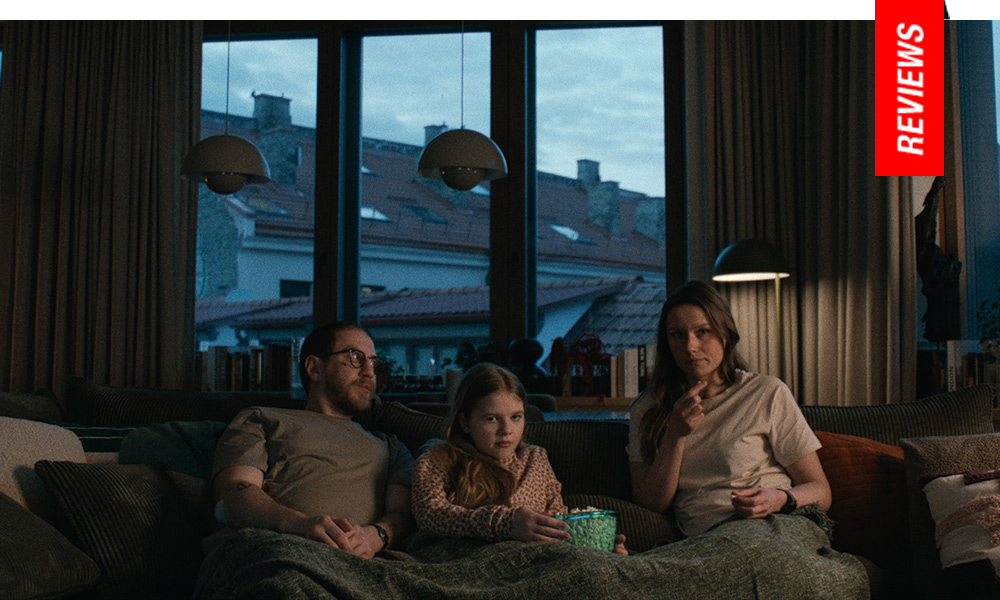
Invisible Missiles: Blaževičius Offers Chilly Portrayal of a Couple & Country in Crisis


Living in Lithuania’s capital of Vilnius, Vytas (Marius Repsys) was once a well respected, trailblazing director in Lithuanian cinema. That is firmly behind him now as he’s settled on becoming a full time husband and caring for Dovile (Amelija Adomaityte). He’s out of work despite rumblings of writing another script but there is a sense of inadequateness lodged within him only growing as the time away from his heydays grows. His wife Marija (Zygimante Elena Jakstaite) is done with the life they’ve constructed, she has a well-paid job at production company “Hungry Rabbit” which produces algorithmic nonsense that gets online views but stalls creativity. The two lead actors are superb and the slump in their marriage is evident from the onset. Jakstaite is particularly versatile as Marija, her face in a constant twist of resignation, that deep disdain only years of a disappointing marriage could conjure. When Marija calls for a divorce Vytas is thrown into turmoil, forced to move back in with his parents and without any steady income. The emerging Russia-Ukraine war in the background pushes the pair into a flux state of performance activism, one-upmanship and an unaware assessment of their privilege.
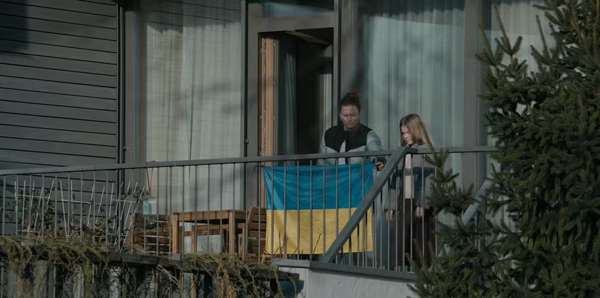

The film explores contradictions on both personal and political levels. Lithuania, caught between Russia and Ukraine, mirrors Dorvile’s position amid her parents’ conflicts—close enough to turmoil to feel its effects, yet distant enough for life to carry on. Vytas engages in relief efforts, boosting his public image while inflating his ego, while Marija navigates a work relationship complicated by ethical compromises and hosts a Russian family, quickly overwhelmed. The story critiques modern performative activism, showing how the desire to appear good—through donations or social posturing—often eclipses real responsibility. In this dynamic, Dorvile becomes the silent center, managing her parents’ divorce with maturity even as their selfish preoccupations leave her isolated. Vytas and Marija are unequipped for the sustained effort real commitment demands, revealing a quiet incapacity for sacrifice that shapes their fractured existence.
The direction is slow and concise, the camera rarely moves and while it is beautifully framed and shot by cinematographer Narvydas Naujalis (who also shot Blaževičius’ Runner) there is a lack of urgency that can become lethargic and plodding. There is a sequence where Vytas attempts to destroy his parents’ satellite dish to stop them watching Russian news propaganda that encapsulates the film. He climbs a ladder and starts whacking it with a spade, a small and ultimately hapless attempt at stopping something far bigger than him. Not unlike Kelly Reichardt cinema but with a less defined style, at over 108 minutes, How to Divorce During the War struggles to be what it’s not—a conceit that begins to wear thin.
Reviewed on January 28th – 2026 Sundance Film Festival (41st edition) – World Cinema Dramatic Competition section. 108 mins.
★★★/☆☆☆☆☆