
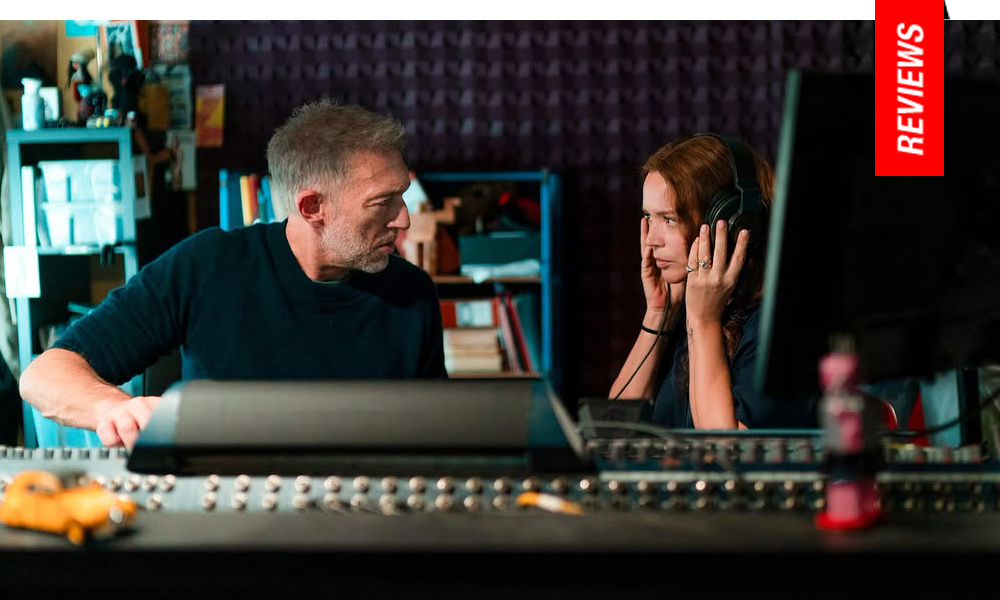
The Double Life of the Voyeurist: Farhadi Fails with Out of Touch Drama


Sylvia (Isabelle Huppert) is a cantankerous writer struggling for inspiration on her latest manuscript. She’s become fascinated by a woman who works in the building across the street who reminds her of her mother, deciding to name her Anna (Virginie Efira) and make her the protagonist of her novel, which includes the men Anna works with, Pierre (Vincent Cassel) and Christophe (Pierre Niney). In Sylvie’s tale, Anna is cheating on her boyfriend Christophe with the older Pierre. Fiction begins to inform reality when Sylvia’s niece (India Hair), who is saved from a pickpocket on the subway by a magical unhoused man named Adam (Adam Bessa), brings her new friend to Sylvia, hiring him to help pack her aunt’s belongings for an impending move. Adam reads Sylvia’s manuscript and decides to follow the woman known as Anna. Anna, as it turns out, is actually named Nita, and she’s in a romantic relationship with Pierre (who is really named Nicolas), whom she works with alongside his younger brother Theo (who is Christophe in the manuscript). The three of them make sound effects for film in the studio Sylvie has been spying on them in. However, Adam gives the manuscript to Anna/Nita, claiming he wrote it. When Nita’s coworkers read it, they begin to be affected by the possibilities of acting like the men someone else wrote them to be.
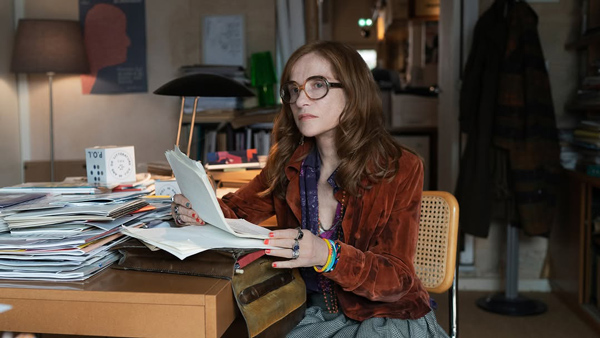

Farhadi’s take on Kieślowski owes as much to Georges Simeonon’s Monsieur Hire’s Engagement (adapted by Julien Duvivier in 1946 and Patrice Leconte in 1989), which is directly referenced by Catherine Deneuve as a smug publisher (which is her only sequence, an amusing but odd reunion with Huppert which recalls another similar vis à vis they shared in Lines of Wellington, 2012). It’s a moment solidifying Sylvie as the dramatic catalyst of a narrative which splinters into several different strands, which includes the rather cliche novel she’s written based on her fantasy of the neighbors, which then bleeds over into the reality of the neighbors after they’re affected by her prose. This is then complicated by the involvement of the homeless man her niece has employed to assist her in moving, as his claims of writing and spying seem more sinister to the trio being observed.
Sylvie feels like something of an infection, a literal toxin whose oblivious musings destroy the lives of others she’s been monitoring, like a Gorgon. Farhadi tries to assert some pathos by making her responsible for realizing another neighbor she spies on must be dead, his decaying corpse eventually located thanks to her intervention. Likewise, she warms (quite unbelievably) towards Adam despite a compendium of red flags. Huppert feels particularly wasted here as a Grey Gardens style recluse who eats tuna out of cans and allows a strange man to scrape mold off a rotting debris into an infected open wound on her foot.
But if there’s anything uniform about Parallel Tales, it’s how inauthentic the women characterizations feel. If Huppert is almost a mythical caricature, her Elle (2016) co-star Virginie Efira really feels objectified based on how Cassel response following an assault which is loosely inspired by the tawdry prose of Sylvia (magnified by Adam Bessa’s plagiarist). In short, Farhadi’s (whose 2013 French language debut The Past at least benefited from Berenice Bejo’s committed performance) modern French women are chain-smoking, ornery gatekeepers or foolish victims (which includes India Hair playing Huppert’s dowdy niece). They rival the hand-wringing silliness of Penelope Cruz, wailing on the staircase for a disappeared person in Farhadi’s 2018 Everybody Knows (read review).
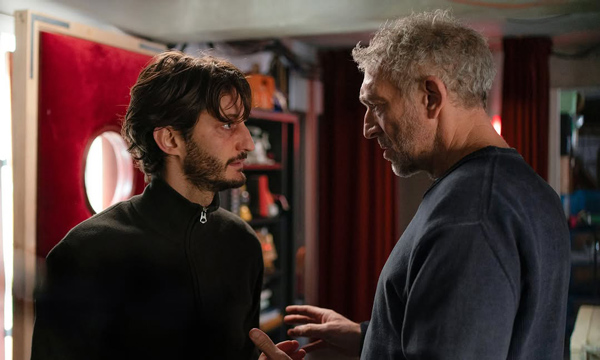

Earlier reports of Farhadi’s latest project suggested it was intended to be set in the aftermath of the November 2015 attacks in Paris, but no particular context is actually employed. However, Farhadi could have avoided a lot of unintentional comedy by actually providing some subtext for the bizarre Nat Geo type film project Nicolas and his skeleton crew are so (supposedly) stressfully mired in. The amount of animal sounds they have to mimic suggest a live action remake of a zoological procession not conceived since Noah’s Ark.
By its final throes, which begin to take on a Hitchcockian element (particularly if one can recall a strangling sequence from Torn Curtain, 1966), Parallel Tales feels completely hollow. Whatever its formidable inspiration might be, this could have easily been titled A Long Film About Peeping based on how bluntly it mangles the complex themes of Kieślowski or Simenon.
Reviewed on May 15 at the 2026 Cannes Film Festival (79th edition) – Competition. 140 Mins.
★★/☆☆☆☆☆
“ ”