Post My Summer of Love (2004) and The Woman in the Fifth (2011), it’s with his fourth feature where Paweł Pawlikowski become someone to factor as a Croisette conversation whatever future output after showcasing Ida – it garnered 70 international awards, including five European Film Awards and the 2015 Academy Award for Best Foreign Language Film. So he would win Best Director Prize at Cannes in 2018 for Cold War (read our review) and so its been a long eight years (some squashed projects) until now. He tends to work on themes of identity and belonging in the wake of historical rupture; the weight of the past — political and personal — on intimate relationships; and a precise, elliptical visual style in which black-and-white images carry enormous moral weight. Fatherland centres on the relationship between Nobel Prize-winning writer Thomas Mann and his daughter Erika, actress, writer, and rally driver. Set during the summer of 1949 at the height of the Cold War, the film follows a father and daughter on an emotionally fraught journey from American-controlled Frankfurt to Soviet-occupied Weimar, where the divisions tearing apart postwar Germany begin to mirror the growing fractures within their own family. Hanns Zischler and Sandra Hüller topline the Poland, United Kingdom, France, Italy and Germany co-production. This is competition film #3 of 22.
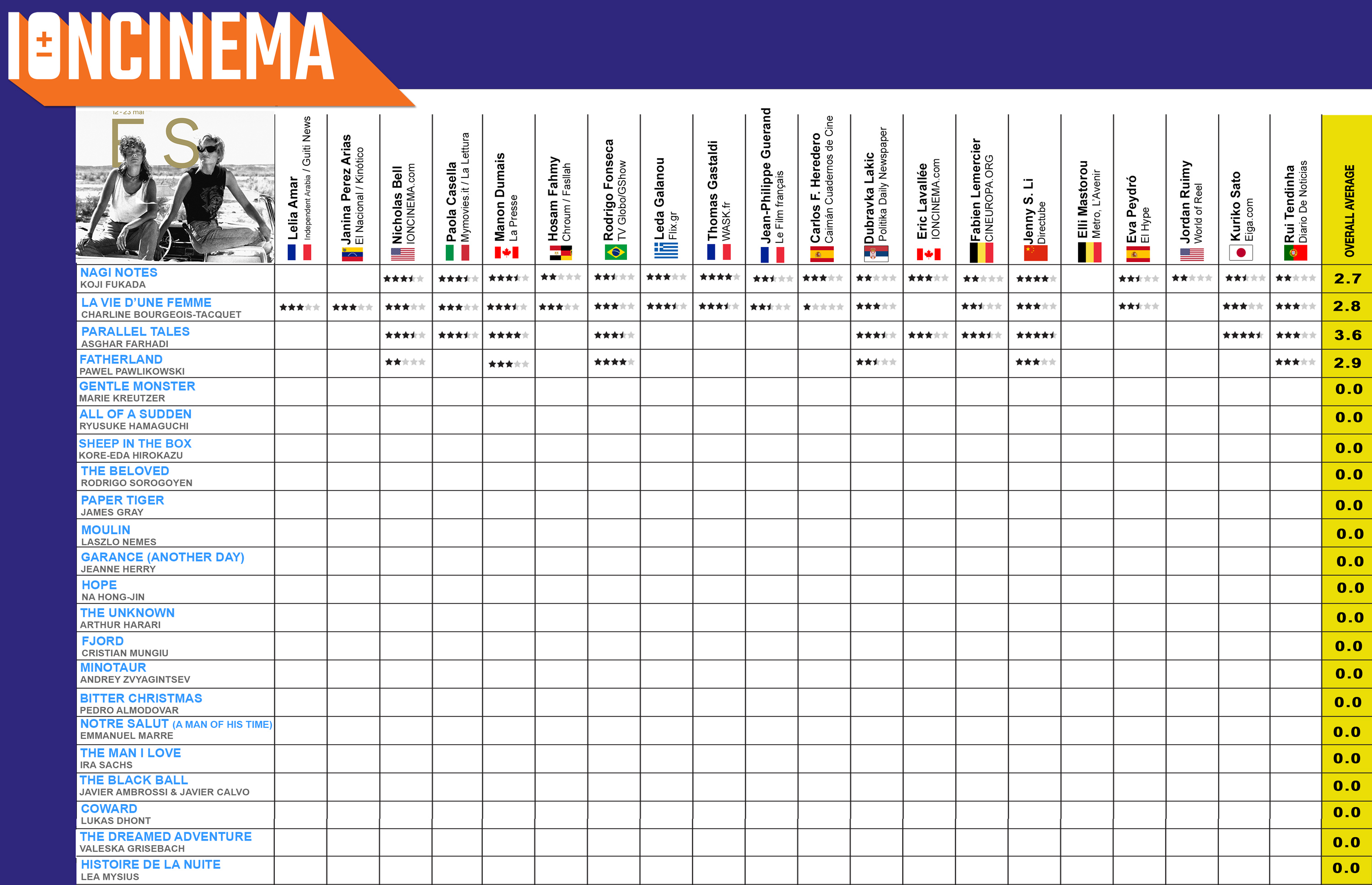
In 2018, his Cold War ended up with the excellent average score of 3.7. At this exact point, after half our jury have shared their notes – we have another 3.7 which means the likelihood of Fatherland being cemented as one of the best critically received films at this year’s edition is as factually as black and white as the film.
Click on the grid below for a larger version and latest updates!