
Love Audit: de la Rosa Defies the Odds with Star-Crossed Lovers


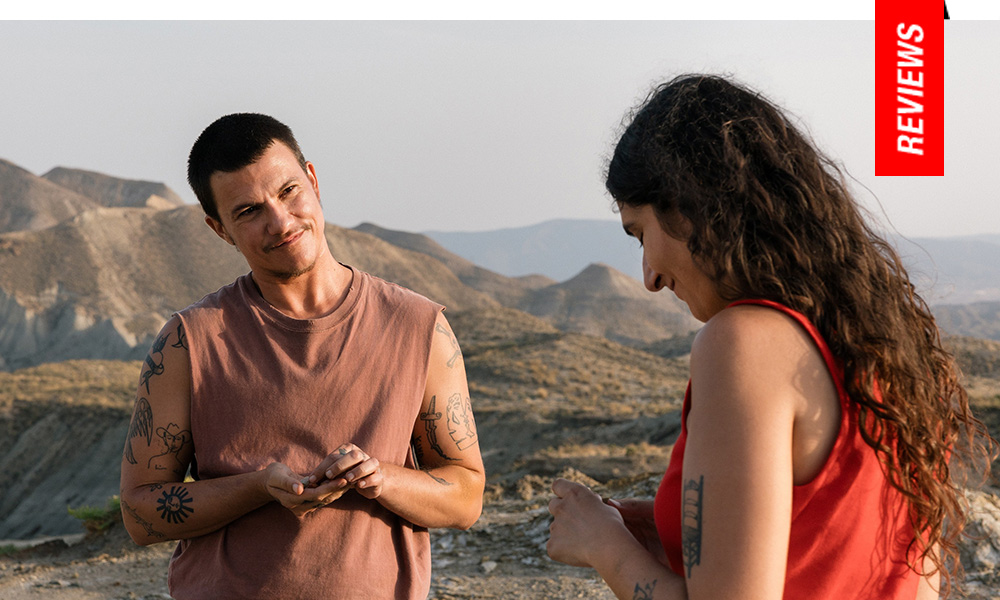
Iván (Silver) works as a line manager in their family’s well-established warehouse, currently owned and operated by their uncle Manuel (Nico Montoya), though the demise and death of Iván’s father suggests buried familial strife. Struggling to get a promotion from his omnipotent uncle, who has looming plans to sell the business, Ivan’s also somewhat of a black sheep, as being trans may have somewhat disrupted their potential trajectory, which included studying agricultural engineering. One day, Hadoum (Herminia Loh Moreno) is involved with an accident on the packaging line, but she’s dissuaded from seeking medical attention. Iván disagrees with the situation, but keeps checking in on her, and soon their mutual attraction leads to a reluctantly defined courtship. But Hadoum’s family, who are Moroccan immigrants, remain suspicious of Iván. Likewise, Iván’s family isn’t too excited about their dating one of the workers, sensing a conflict of interest just waiting to rear its head.
Xenophobia and misogyny, rather than directly articulated transphobia, are the well-utilized tools compromising the successful growth between Iván and Hadoum, employer and employee. As an immigrant, Hadoum’s cultural identity suggests her status will forever be designated as second class, doomed to remain a member of the labor force in Spain. Opinions on Iván are defined by euphemism, a blood relative of the warehouse’s owners who is often referred to as a ‘hybrid,’ but it’s clear their sympathies are aligned with the disenfranchised. A tentative romance blossoms after hours, resembling something like Thomas Stuber’s slight In the Aisles (2018), wherein Franz Rogowski and Sandra Huller bond behind the scenes at a supermarket. But as lust burns into the realm of romance, there’s more of a Romeo and Juliet development between their respective families, both clans dubious enough to feed into the impending doom of an upcoming warehouse audit, which the workers intend on sabotaging.
A myriad of unresolved issues within Iván’s familial unit heighten the dramatic stakes. Iván’s uncle Manuel is on the verge of selling the business, which he may have been commandeered from under his brother, adding a sense of working class Shakespearean tragedy to the proceedings. Likewise, the projected profits of the sale will allow Iván’s nuclear family, including his mother, sister, and nephew, to finally leave behind a cramped apartment so they can luxuriate at a seaside property. Iván’s promotion from line manager to warehouse manager is also a dangling carrot holding them back from doing the right thing, even as Hadoum makes clear she has plans to leave everything behind for better opportunities elsewhere.
The film’s greatest potency is as a sensual romance between its lead characters, their relationship goading a member of a controlling class to remove themselves from an exploitative cycle which might be financially sound but ultimately soul crushing. Partially this is due to the subtle chemistry built between newcomers Silver and Herminia Low Moreno (a musical artist better known under her stage name, Restinga). While the parameters of the narrative are quietly familiar, Iván & Hadoum also feels subversively anarchic in its representation of dimensional characterization, reflecting how being trans is merely one element of an identity instead of the eclipsing factor defining every human interaction.
Reviewed on February 13th at the 2026 Berlin International Film Festival (76th edition) – Panorama section. 100 mins.
★★★/☆☆☆☆☆