
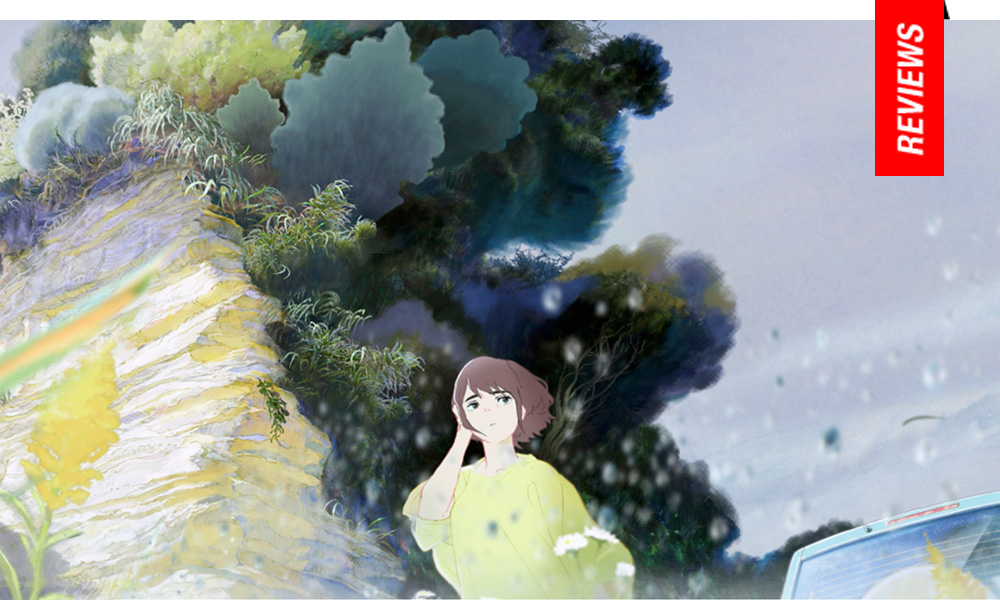
Grave of the Fireworks: Shinomiya Finds All the Colors in the Dark
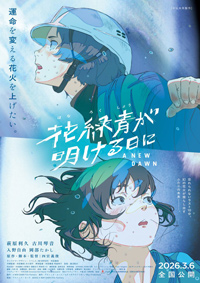

The Obinata Firework Factory has been scheduled to be shut down and demolished thanks to an impending road destined to be built over it. A family business that’s fallen somewhat into obscurity thanks to an increased attitude regarding the uselessness of fireworks in Ajiro Town (thanks in part to diminishing economic possibilities in the area), we meet anguished brothers Sentaro and Keitaro, who have opposite viewpoints. Keitaro desires his father complete the construction of a firework called the Shuhari, which is supposedly so visually spectacular it unveils the mechanism of the universe. But Mr. Obinata claims this firework is a myth, despite having various complex blueprints outlining how it can be built. As their father abandons the business, Sentaro, along with childhood neighbor and friend, Kaoru, move to Tokyo. Meanwhile Keitaro refuses to leave their home, toiling away at building Shuhari all on his own. Four years pass, and on the eve of the house’s impending destruction, Sentaro takes Kaoru back to Ajiro Town to try and get Keitaro out of the house. But they’re surprised at what they find when they return.
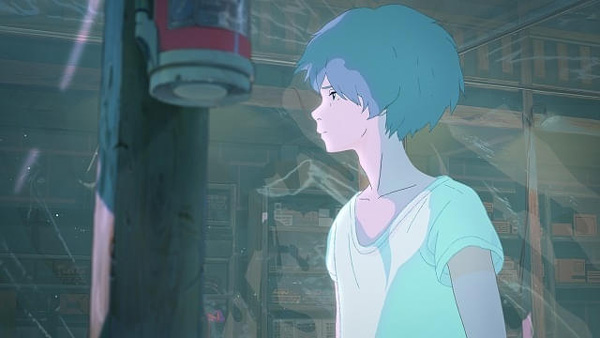

The plot mechanisms of A New Dawn are so earnest and yet so insanely stitched together it would seem better utilized as an installation to parallel a hallucinogenic drug trip at the movie theater, especially if one holds out for the expected finale. Outside of this, Shinomiya otherwise formulates a somewhat familiar environmentally aware animated film but without the formidable world building of, say, a Miyazaki (as this film feels more like it could be called Dispirited Away), asking sometimes painfully obvious questions in the dialogue, such as “Why doesn’t anyone take responsibility?”
The main character conflict exists between Kaoru, whose family was at odds with Mr. Obinata, thus affecting her somewhat sisterly bond with brother Keitaro and Sentaro. Their rival attitudes have dictated whether they view her as foe or family. Sentaro, described as a ‘rising star from city hall,’ is the ‘sell-out,’ an administrative ‘yes’ man who has become part of the corporate machine. His affections for Kaoru provide some aspects of comic relief, such as when they collude to get Sentaro drunk as a way to distract him from their plan to unleash the hurricane seized Shuhari firework, resulting in a rather novel display of stop-motion animation to suggest his wild, inebriated perspective. Keitaro, on the other hand, is about as well-adjusted as any garden variety mad scientist, his fervor for the fireworks reminiscent of someone like Harrison Ford in Peter Weir’s adaptation of The Mosquito Coast (1986).
Strange, but not particularly cohesive, A New Dawn doesn’t quite live up to its title or the prestige of being a debut animation feature bowing in competition at a major film festival. An impressive mix of textures and frameworks suggest Shinomiya is definitely an artist with something to say, but his debut is all about climax. In short, as a film, it’s too adolescent with its foreplay.
Reviewed on February 17th at the 2026 Berlin International Film Festival (76th edition) – Main Competition. 76 mins.
★★/☆☆☆☆☆