

Death Be Not Loud: Deruas Kills a Teen Dream in Languid Period Piece


Charlotte (Garrel) and Liza (Louiza Aura) are best friends whose whole lives are ahead of them. Finishing up their senior year of high school in the early 1990s, they dream of leaving behind the suburban malaise of their parents in the South of France to start their own Parisian rock band. Their flight to the city feels more imperative for Charlotte, whose tenuous relationship with her father (Gerard Watkins) is about to erode beyond repair, while her unhappy mother (Emmanuelle Béart) seems poised for a similar change. Tragedy strikes when Liza begins suffering from troubling symptoms, collapsing at school and experiencing alarming memory issues. When the worst possible scenario transpires, Charlotte must reassess a future she’d seemed so sure about.
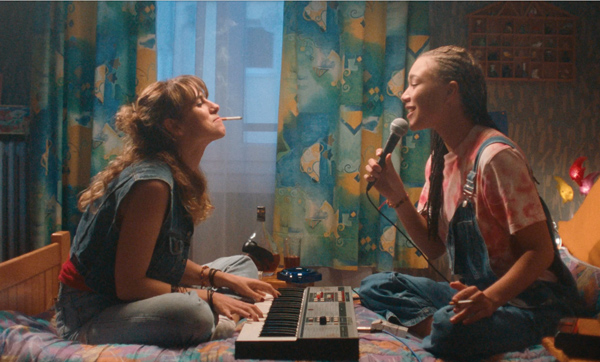

While we’re mostly accustomed to this sub-genre through the mechanism of adult women confronted with their own mortality, Stereo Girls oddly feels as if it’s the younger sibling of Beaches (1988), sans the heightened emotions channeled by the likes of a Bette Midler or Barbara Hershey. Tonally, Deruas adopts a more free-spirited, less defined approach to Charlotte and Liza, and thus feels a bit less distinctive, similar to any number of other recent friendship films where specific circumstances test their alliance, such as Claire Burger’s Langue étrangère (2024).
One gets the sense the young women would have eventually drifted apart based on Liza’s reticence on moving to Paris, her focus shifting towards romantic inclinations for a local boy. More pronounced is the increasingly destructive behavior of Charlotte’s parents, with harried mother Emmanuelle Béart feeling trapped by her oppressive husband’s political leanings, meant to reflect the rising conservative political shift in 1990s France. The chemistry between Beart and Garrel suggests a more interesting film, in the vein of This Boy’s Life (1993), would have honed in on the relationship between a mother and daughter removing themselves from the suburban microcosm of their patriarchal trapping by simply bonding and absconding together.


Garrel, like her elder siblings who often appear in father Philippe Garrel’s films, is a comfortable, affable screen presence, but a dependence on belaboring the obvious (most evident in spurts of omniscient narration) tend to soften anything resembling sharp, emotional corners. Cinematographer Vincent Biron, a notable figure in contemporary Quebecois cinema thanks to his work on Denis Cote’s Bestiaire (2012) and Matthew Rankin’s The Twentieth Century (2019), appears to have less room for creating striking or peculiar frames, instead channeling a more standardized, period suburban look. A tragedy-tinged fairy tale, Stereo Girls sings a familiar tune with too much emotional distortion.
Reviewed on August 28th at the 2025 Venice Film Festival (82nd edition) – International Critics’ Week – Opening Film. 80 Mins.
★★½/☆☆☆☆☆