

Cinematic Universe: Quentin Tarantino’s Cliff Booth Becomes A Superhero
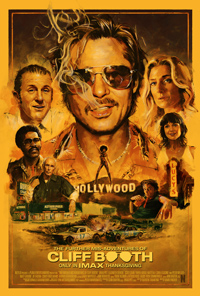 Can the calculated precision of director David Fincher navigate the pulpy attitude of writer Quentin Tarantino? That’s the question behind the Big Kahuna sized sequel to Tarantino’s Once Upon A Time In Hollywood. The result, unfortunately, is a film that’s as awkward as its marble mouthed title The Further Mis-Adventures Of Cliff Booth. If the previous picture was both a love letter and revisionist portrait of the era just as New Hollywood began to crest, the followup is an oversexed mash note to the everyman hero Cliff Booth.
It’s 1977 and, as we’re reminded several times throughout the film, Cliff’s former boss, actor Rick Dalton, is now starring in Dingo Dan, a hit TV show in Australia. Dalton has put on some weight which means the still lean and handsome Cliff has stayed behind in California. The former stuntman now lives with his Dad (Peter Weller) and works a number of odd jobs including: projectionist at the (currently Tarantino-owned) New Beverly Cinema; bartender who makes the meanest drinks in town; flashy demolition derby driver; and unofficial fixer for anyone in the industry who might have a problem they need solved. The latter is illustrated in the film’s lengthy opening sequence. Cliff is hired to deal with a couple of goons who’ve robbed a closeted, legendary filmmaker of his valuables — including an Oscar — in exchange for a stack of cash. The cool as a cucumber Cliff gets rid of them both and keeps the money for himself.
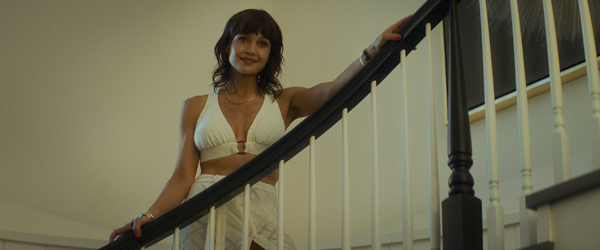
The shaggy film (Fincher revealed he axed 60 pages from an original 230 page script — he could’ve taken out more) eventually sees Cliff fall into the orbit of talent agent Karen Crosby (Elizabeth Debicki), and her client, TV star Charlie Peters (Scott Caan). It turns out Charlie has a problem with some Filipino contract killers and is sussing out whether or not Cliff can help. Of course he can!
The Mis-Adventures Of Cliff Booth is Tarantino’s long-winded paean to the amazingness of his own creation, Cliff Booth. Played with zero new notes by Brad Pitt, he’s the man every guy wants to be and every woman wants, an impressive and gentlemanly porn star (one of his other jobs), plus an “American hero of the Philippine resistance” (seriously). Cliff Booth is figuratively a superhero and literally a man of myth. There’s an entire scene dedicated to characters remembering the time he beat up Bruce Lee. There’s nothing he can’t do and the film’s brutal, cartoonish climatic sequence underscores that under every circumstance Cliff Booth will be the last man standing, looking hot as hell, with a one liner at the ready.
To be fair, Tarantino has an audience ready to delight in his dialogue. They will undoubtedly enjoy a long, meandering conversation about the acting style of Ralph Meeker. Just as they will get a kick out of Cliff Booth explaining that if you want to know what it’s like to kill a man, try doing it to a pig. They will surely be ecstatic to hear Tarantino doing the voice-over in a montage sequence summarizing the career of Charlie Peters (which features a disturbingly AI-looking collection of magazine covers). But those fans might also sense something is off and they won’t be wrong. That’s because Fincher just doesn’t have the looseness Tarantino’s characters and words require. The film’s insouciant vibe feels more recited than lived in; the repartee frequently landing dead-on-arrival. And it’s not because the cast isn’t doing their damndest. In fact, Debicki, Weller, and Caan push past Fincher’s perfectionist tendencies to bring dimension to their thinly sketched characters. Debicki in particular, drawn to Cliff even though she knows deep down he’s bad news, is great as a lonely woman at the top of her game professionally but losing in her personal life.
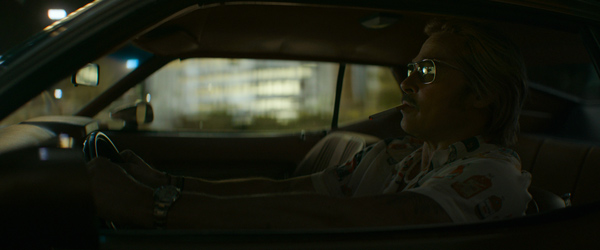
Ultimately, however, The Further Mis-Adventures Of Cliff Booth is movie that’s not about anything but itself. Its makers are in thrall to the fastidious recreation of late ‘70s Hollywood (even if the use of AC/DC’s “Dirty Deeds Done Dirt Cheap” is anachronistic — it didn’t come out in the United States until 1981), its eccentrics, and its culture and communities (that are, once again, mostly white). But Tarantino and Fincher have nothing to say about that particular moment in America (the premieres of both Star Wars and Looking For Mr. Goodbar are background events) beyond a fetish for its neon marquee, rotary phone, heavy wood desk, thick rug surfaces.
Formerly a film critic, Karen reveals that she believes movies can’t be art; their main goal is to be fun. You couldn’t be faulted for thinking Fincher and Tarantino believe the same thing. Because there’s nothing in any frame that aspires to be anything more than expensive Cliff Booth fanfiction. For a lot people, that will likely be enough. But for everyone else, this is one adventure that can be skipped.
★½/☆☆☆☆☆