

Family Rituals: Gomis Goes For Broke in Sprawling Epic
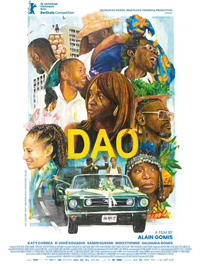 With his first narrative feature in nearly a decade, French-Senegalese director Alain Gomis formulates a complex tapestry with Dao, which is defined as “a perpetual and circular movement which flows in everything and unites.” The key words here are ‘flow’ and ‘unites,’ as Gomis throws everything and the kitchen sink into a freewheeling docudrama which feels akin to navigating a Cristi Puiu ensemble. Impressively assembled with much to admire, there are moments which often suggest the film could be a masterpiece. However, there’s also often a meandering, even lethargic pacing as the narrative flits between two key events in Paris and Guinea-Bissau, and it often feels like a more fastidiously edited cut might assist in honing its three-hour plus running time into something more elegant.
A casting process begins for a film project about a single mother of African descent whose daughter is about to be married and whose deceased father is scheduled to have a grand commemoration ceremony in her native country. A voice offscreen confirms there will be professional and first-time actors. After multiple women are interviewed, it appears Gloria will be portrayed by Katy Correa, her biracial daughter Nour by D’Johé Kouadio. Together they travel to Guinea-Bissau as a multitude of relatives arrive, most meeting Nour for the first time. Meanwhile, Nour’s wedding in Paris, which also includes the presence of extended family, also commences, the events spliced together as they unfold.
Arguably, the central figure is Katy Correa, who we meet as an actor auditioning for the role of Gloria. We see her running scenes with other actors who eventually appear in the narrative portions of the film. She’s an inviting, soulful presence, and carries with her a sense of constant melancholy, reminiscent of someone like Mary J. Blige (with whom she also shares an affinity for wig choices she might later regret). Gloria even gets a sequence of dialogue with her ex-husband that feels ripped from the lyrics of an MJB track, suggesting she’s finally happy with a new partner, but the feeling is too new for her to actually show it. With Gomis’ inclusion of the casting process, Dao eventually begins to feel like a Mike Leigh workshop of On Becoming a Guinea Fowl (2024), sans the distressing sexual abuse defining Rungano Nyoni’s feature.
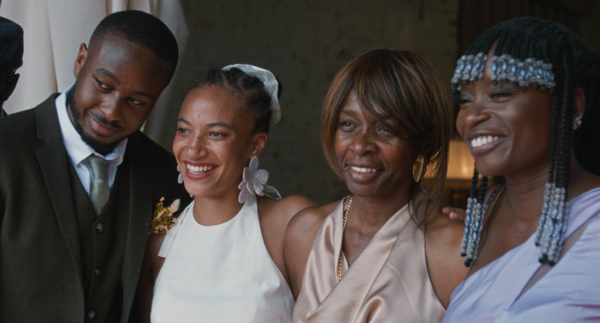
A sprawling carousel of characters unite in Guinea-Bissau, and this is also where the film tends to drag, particularly with repetitive introductory scenes with people we’ll never interact with again. The livelier portions, involving the celebratory wedding of Nour in Paris, are, by default, more vibrant. It’s here where the meat of familial dramatic conflict unspools. Gloria takes a back seat to the proceedings. A relative named David brings his white, pregnant girlfriend unexpectedly to the event. His own mother gives the most withering response in the shortest amount of screen time since Beatrice Straight, while his siblings question her intelligence for agreeing to meet the family in this fashion. Just because one is invited to the cookout doesn’t mean the circumstances always make it appropriate. But these scenes also provide Gloria with some catharsis, and a sporadic a capella rendition of “Killing Me Softly” from members of the wedding is a sublime height.
There are four credits for Dao’s musical score, which also highlights the film’s ganglionic feel, but there’s a notable, lilting quality which creeps in during ensemble moments, a tinkling piano accompanied by brass, reminiscent of Terence Blanchard’s work with Spike Lee. While the film lives up to the definition of its title, the flow does not always feel cohesive, and is sometimes alienating, especially because a character like Gloria often feels like she deserves the centralized treatment afforded the titular character of his 2017 film Félicité.
Reviewed on February 13th at the 2026 Berlin International Film Festival (76th edition) – Main Competition. 185 mins.
★★★/☆☆☆☆☆