

I Confess: Mohammadi’s Myriad of Memory Celebrates Women of Iran Who Don’t Stand Idly By
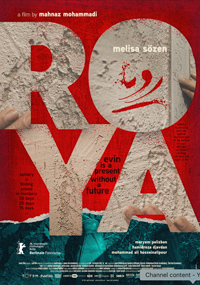 While we understand imprisonment as punishment par excellence, what Iranian filmmaker and activist Mahnaz Mohammadi explores in her searing sophomore feature Roya is how confinement methodically disorients logic, splintering the boundaries between past and present. Drawing from her own experience of incarceration, Mohammadi crafts a two-tiered psychological descent that is at once visually austere and aurally assaultive — jarring, off-putting and formally risky in ways that both immerse and unsettle the viewer. Who knew that there were not one, but two hells.
One of the film’s earliest images — the pressing of an elevator button descending to basement level minus three — becomes a distilled omen of the world of societal pain that awaits. The horror lies not in spectacle but in procedure. An interrogator casually makes birthday plans with the family while preparing to forcibly extract information or lock in a confession. Violence here is blue-collar, clock-in/clock-out labor. Bureaucratic. Repetitive. All the more chilling for its ordinariness. Where Jafar Panahi offered flashes of above-ground catharsis in who holds control in It Was Just an Accident, Mohammadi denies such release. This chilling type of power operates without rupture, and what happens underground will foreshadow the world above ground.
Set largely inside Tehran’s notorious Evin Prison (a setting reported for mock executions, prolonged solitary confinement, forced confessions, sleep deprivation, and sexual abuse) the film follows a schoolteacher (played with hollowed intensity by Melisa Sözen) detained for her beliefs and presented with a false choice: deliver a confession or endure indefinite psychological erosion. Prison becomes more than a three-by-three cell — it is a perceptual corner, a fractured mental architecture where chronology collapses and memory oscillates between sanctuary and threat. Loved ones are alternately declared alive or dead; reprieve itself feels suspect. Echoes of the British television series “The Prisoner” come to mind when we are presented with the cruel mirage of freedom — fleeting moments of apparent clarity that only further warp perception, blurring the line between ally and adversary and leaving trust perpetually compromised.
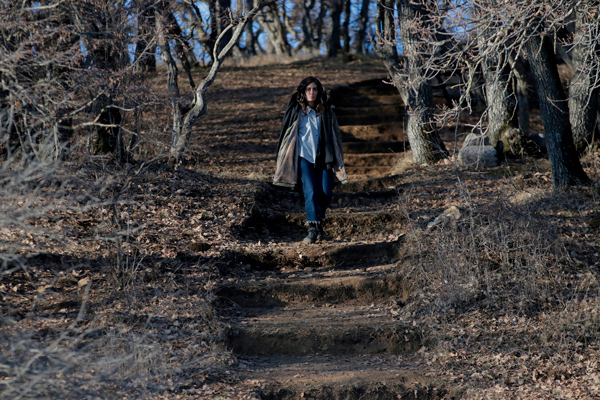
Mohammadi’s immersive POV sequences shot by Ashkan Ashkani (honestly, the first thoughts that come to mind are samples of Timur Bekmambetov POV cinema) place us inside Roya’s destabilized consciousness, revealing how humiliation and manipulated truths corrode certainty. It’s off-putting and takes some getting used to – but what comes next serves the specific propose of pushing the viewer to do active work on their own end. What did we just see? What is real? The screenplay is built around rapid layering of events and shifting relationships with a lot of people to people associations which feel so hastily implemented that coherence often gives way to confusion.
The film’s strength is of course Sözen who embodies mental exhaustion with remarkable restraint. Her Roya is marked by absence — a gaze drained of language, a face etched with silent endurance. Earlier sequences reassemble themselves, reality and hallucination begin to blur, suggesting that survival under authoritarian pressure is less rebellion than fragile self-preservation with strobing flickering lights reminding us that memory are like snapshots coasting in different timeline lanes with those conversations with one’s self are meant to be repeated and revisited. A puzzle-like portrait, Roya is most devastating as a portrait of prison as psychological — constructed from isolation, coercion and the slow dismantling of identity itself. You can’t get more political and more timely than with this text.
Reviewed on February 18th – 2026 Berlin International Film Festival (76th edition) – Panorama section. 92 mins.
★★★/☆☆☆☆☆