

The Cranes Aren’t Flying: Zvyagintsev Unleashes Primordial Tendencies
 “They always end disastrously,” Kate Burton advises Diane Lane of extramarital affairs in Adrian Lyne’s 2002 erotic thriller Unfaithful, a remake of Claude Chabrol’s 1969 classic An Unfaithful Wife. It ends up being an extreme understatement for what transpires in those texts, as well as the affair at the center of the latest domestic drama from Andrey Zvyagintsev, the Russian auteur’s first feature in nearly a decade (following 2017’s divorce debacle, Loveless). Fleshing out a perfect storm of intersecting world events in modern day Russia which significantly impact workplace ethics, a jealous husband is driven over the edge by his neglected wife’s all-consuming affair. Minotaur is a familiar story, to say the least, but a fitting continuation of the director’s clear-eyed deliberations on how intimate relationships present a sordid microcosm of the world at large.
Gleb (Dmitriy Mazurov) and Galina (Iris Lebedva) are an unhappily married couple who seem unable to get beyond a state of stagnation. Thanks to a secret military operation on the Georgian border, a mass exodus of the local population has compromised Gleb’s corporation. Worse, all the local high-profile executives have been summoned by the mayor who relays government orders for them to submit a quota of employees that can be drafted for military service. As Gleb attempts to find a way to make these selections, he hires his head of security to find out who his wife has been having an affair with. With their son’s birthday party right around the corner, Gleb receives confirmation his wife has been regularly seeing Anton (Yuriy Zavalnyouk), a young photographer with whom she seems to have developed feelings for. As his world seems to be crumbling all around him, Gleb decides to pay Anton a visit.
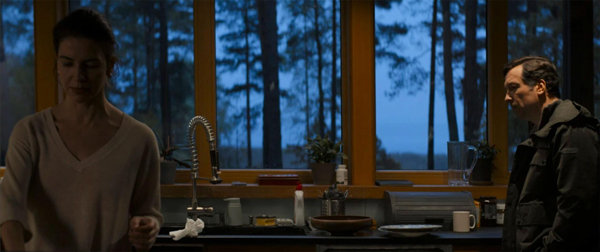
While Zvyagintsev often prizes ambiguous, layered metaphors, such as 2007’s The Banishment or 2014’s Leviathan, his latest is in keeping with the straightforward relationship issues charted in 2011’s Elena, where seemingly well-adjusted characters end up making disastrous, tragic decisions. Dmitriy Mazurov’s Gleb frames this story’s perspective, and it’s evident from the film’s opening frames that something is not right at home. Zvyagintsev employs a fictional special military operation on the Russian-Georgian border which throws their world into an immediate frenzy, an interesting choice for the exiled director in this French co-production, suggesting the endless onslaught of his native country’s hostile takeover mentality and continuous deployment of religious and nationalist propaganda.

If Chabrol and Lyne are certainly comparable, so is Hitchcock’s Dial M for Murder (1954), remade in 1998 by Andrew Davis as A Perfect Murder. Lyne would revisit similar territory with his adaptation of Patricia Highsmith’s Deep Water (2022), a remake of the 1981 version starring Isabelle Huppert and Jean-Louis Trintignant from Michel Deville. Clearly, these are primal tendencies and tropes in the murderous adultery template, and Zvyagintsev certainly delivers.
Returning to work with DP Mikhail Krichman (who he’s been involved with since his 2003 Golden Lion winner, The Return), it’s a ravishingly shot portrait of autumnal discord. The beautiful Iris Lebedva as Galina is barely concealing her adulterous relationship, signaling potential plans to leave her family, if they aren’t already imminent. The noose around the situation is somewhat of a slow coil, as Gleb is putting out fires at work by utilizing a rather cruel loophole, hiring fourteen new employees on a permanent contract, strangers he doesn’t have to feel guilty about feeding to his country’s bottomless war machine.
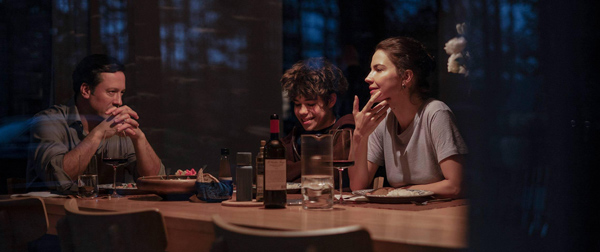
Digging deeper, when characters are able to openly engage with their vitriol, no one seems happy, particularly Zvyagintsev’s women. A night of dining and drinks with old friends finds one man in mid-life crisis mode with his new younger girlfriend, who seems content so far in their honeymoon phase. Galina gossips in the bathroom with another wife from their cohort, who despises the younger woman. “A happy wife knows nothing,” she confirms. Galina herself is able to articulate she wants more than to just ‘endure,’ but their gripes seem cruelly self-consuming based on what’s going on around them. They have the privilege of being oblivious, visualized by a final sequence where they’re looking down at the world from above the clouds.
The title, referencing the mythical Greek creature whom Theseus defeats in the labyrinth, is the symbolic insignia of both Gleb and Galina, a metaphor for their base level fears and desires dictating their actions. Eventually, it appears Gleb is indeed a ‘citizen above suspicion,’ slickly using the woes of the world to conveniently and selfishly reclaim authority over his own hearth.
Reviewed on May 19th at the 2026 Cannes Film Festival (79th edition) – Competition. 142 Mins
★★★★/☆☆☆☆☆