
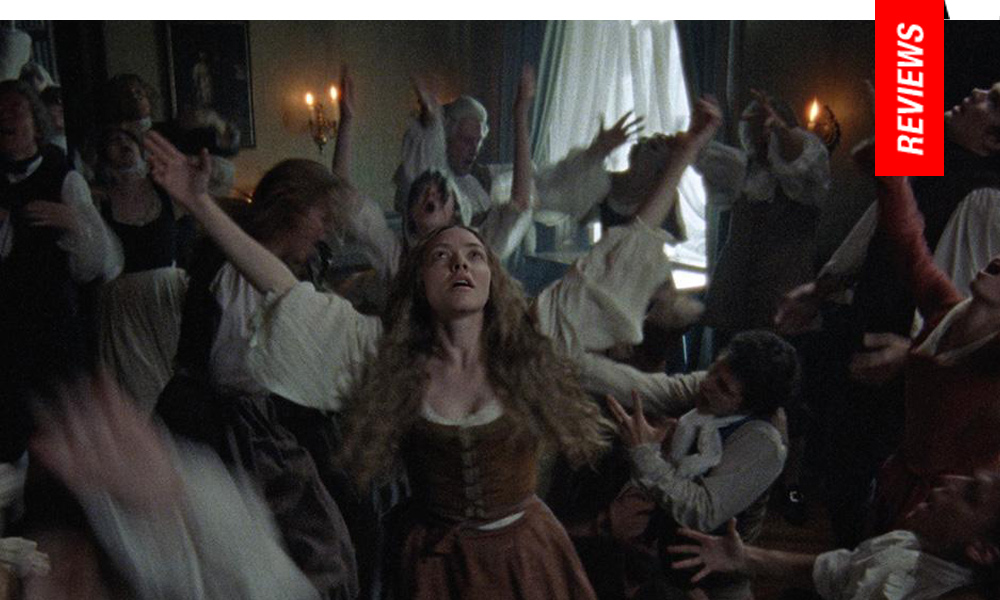
Shake It Up: Fastvold Envisions the Life’s Work of a Religious Leader


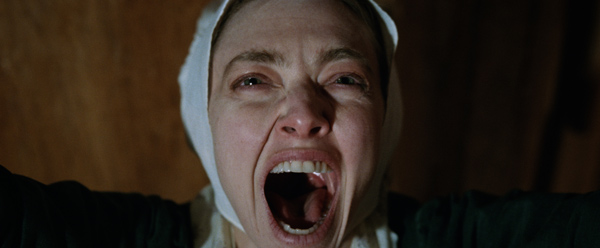
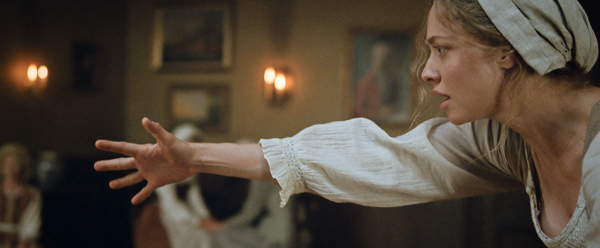

In 1736 Manchester, Ann Lee and her younger brother William were inseparable. Childhood experiences provoke a distaste for reproductive realities. As a young woman (Amanda Seyfried), she takes her brother (Lewis Pullman) and one of their nieces to a sermon led by Jane Wardley (Stacy Martin), who has originated a religious group with her husband known as the Shakers (so named for their loud singing and gyrating dances). As time goes on, Ann Lee becomes the prominent leader of the group, and with the help of a benefactor, they embark for New England when she professes God has directed her to spread their gospel in America. However, their beliefs declare men and women should be wedded to their lord and savior, foregoing pleasures of the flesh eternally. Those unable to heed this dictate cannot be part of the community.
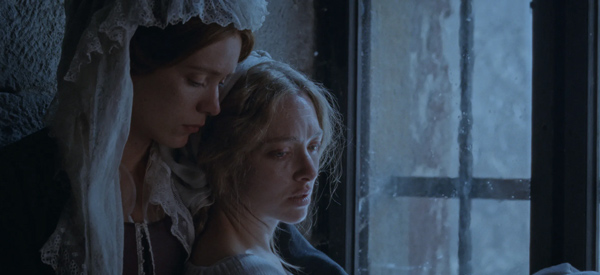

To its detriment, The Testament of Ann Lee bops around on its own specific wavelength for almost the entirety of its running time, rarely fluctuating in tone. The lilting narration of Thomasin Mackenzie, who also portrays Sister Mary, a member of the congregation, fittingly outlines fanciful moments of witness accounts, such as the visions experienced by Ann, interpreted as signs from God. But the narrative, divided into three chapters, which don’t ever feel distinctive, at least as far as segues, eventually feels a bit detached from its central figure. Until brutal violence strikes and Ann’s temple is burned to the ground, her brother beaten to death.
The music from Daniel Blumberg lends an unavoidable pagan quality to the proceedings, as rarely has a white religious congregation seemed so happily harmonious and rhythmically in sync. As depicted here (choreographed by Celia Rowlson-Hall), with its ritualistic choreography set to its jaunty tunes, it’s no wonder Ann Lee seemed so appealing to both men and women, despite its congregation basically agreeing to be a bunch of horny singles. If only the community averse to dancing in Footloose (1984) had known of Ann Lee. At times, this novelistic approach feels humorous, like Celibacy: The Musical, but Lee’s convictions were born from significant trauma, having birthed four children, all who died before they reached their first birthday. Fastvold suggests Lee was averse to pleasures of the flesh as a child, witnessing her mother’s endless procreative functions in dismay. A sequence where the youthful Ann confronts her father after witnessing his ‘rutting’ recalls a similar sequence in The Thorn Birds (1983).
Lee’s revolutionary line of thought, which dictated women who engaged in sexual congress could not properly worship Christ, obviously leads to a confrontation with her husband (Christopher Abbott, cuckolded again by Fatsvold after her exquisite 2020’s The World to Come read review), who didn’t sign up for celibacy when he married. Their dissolution isn’t quite as confrontational as one might expect, though her methods suggest Ann Lee was a prototype for Andrea Dworkin.
Tonally, William Rexer’s lavish cinematography perfectly creates the specific environment, shot on 70mm with what appears to be natural lighting in an impressive production design shot in Budapest. Ultimately, The Testament of Ann Lee feels like Willa Cather’s version of The Witch (2015). Sadly, the Shakers don’t go on singing after her death, but Fastvold’s recapitulation is food for thought regarding philosophical progress cut short by the silencing of someone like Ann Lee, who, unlike an Aimee Semple McPherson, was constructing a harmonious community with a gospel embracing the joy of living.
Reviewed on September 1st at the 2025 Venice Film Festival (82nd edition) – In Competition. 130 Mins
★★★/☆☆☆☆☆