

Destroy Everything You Touch: Abraham & Szor Explore the Cogs of the Palestinian Genocide
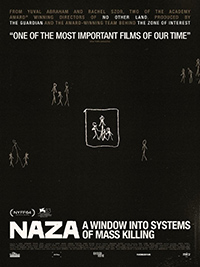 Investigative journalists and documentarians Rachel Szor and Yuval Abraham follow up their Academy Award winning 2024 debut No Other Land with an exploration of the ongoing Palestinian genocide in Naza. Shot over three years from the rooftops of Tel Aviv, twenty-four Israeli intelligence specialists are interviewed, their identities undisclosed, faces and voices obscured as they relay not just information about Israel’s tactics in flattening Gaza but also how they process or understand their roles in murdering innocent women and children. The information covered in the film has already been reported, so there’s nothing exactly revelatory for those who’ve been paying attention. However, as is outlined in their director’s statement, the documentary was made out of a ‘sense of obligation,’ and viewing it should be met with the same sense of duty. Unfortunately, anything interpreted as bearing any sense of onus on those ignorantly clutching to opposing viewpoints or those dissuaded by anything suggestive of liberal tendencies presumably will find any excuse to deny, dismiss, or avoid it. However, their clear-eyed, sobering approach is indeed an undeniable document of complicity and admission to the systematic murdering of an entire people, and it’s unclear how anyone could continue to hide behind political jargon after being confronted with both the facts and the dehumanizing attitudes on full display.
The title refers to terminology describing collateral damage, i.e., the women and children who are killed in Israel’s targeting of Hamas operatives in Gaza. It’s the same tactic historically used by law enforcement in the United States when referring to sex workers as N.H.I., ‘No Humans Involved,’ as an effective way to compartmentalize how violence and carnage exacted against other humans can be justifiable.
There’s an absolute sense of surreality at play as the interview subjects speak directly to how they grew up believing, and still do, that Nazis are evil, but have grown to understand, accept, and condone their actions eradicating the Palestinians. Others attempt to suggest a semblance of humanity, as if an ember of empathy exists somewhere deep down, such as one agent who admits to being upset by watching dogs eat Palestinian corpses. The rules of engagement, for those desiring some kind of escapist comparison to ponder, have shifted past a point of no return into the arena of war crimes, and, like Odysseus’ inequitable trickery with the Trojan Horse, promise a reckoning for Israel which will one day come. But Israel is not Germany of the 1920s and 1930s, a country on America’s shit list following the end of WWI. Israel remains a wealthy ally to a country undergoing its own fascist dismantling.
What’s perhaps most troubling is another shift in the normalization of war crimes as something we’re either helpless to stop or doomed to endlessly repeat as a species. Another operative speaks to a common thrill many of them experience after a ‘successful’ operation, akin to the adrenaline rush of a video game, sheltered by the safety of distance as opposed to, say, what American soldiers experienced during the Vietnam War, where a similar sentiment about an entire country being the enemy allowed for egregious, brutal violence and murder, with intergenerational ripple effects informing a myriad of mental health issues following their return from the frontline.
Hannah Arendt famously coined the phrase ‘the banality of evil’ following the capture of Adolf Eichmann, whose defense, along with the other Nazis tried at Nuremberg, was about following orders. They had no choice. Nowhere in Naza do any of the subjects reflect any sense of threat to their lives should they refuse to comply with orders (only, rather, that they are just not allowed to say anything humane regarding their targets). But this goes beyond banality towards something much darker, somehow more reprehensible, and scholars will eventually coin new terms to explain what’s happening here, taking into account a modern era codependent on social media, something which has already desensitized and dehumanized us all. Some of the subjects attempt to elude any personal accountability, but the compartmentalization is grossly indecent, their justification recalling lyrics from Ladytron’s track “Soft Power” – “We’re not sleeping at the wheel/the wheel is turning the machine that kills for us.”
Another subject confirms part of their ‘training’ was watching the 2015 film Eye in the Sky, which, in that film’s defense at least attempts to showcase the emotional toll on soldiers who are conflicted about dropping bombs on targets in the Kenya (and trying their best to avoid killing innocent victims, who they refer to in human terms). But it’s another signal. As Isabel Wilkerson outlined in Caste: The Origins of Our Discontents, the Nazis borrowed their ideas for how to eradicate the Jewish population from the United States’ treatment of Black slaves. In turn, the Germans may have informed the cruelty being propagated by Israel against the Palestinians, but American methods certainly play a hand in the arrogance, indifference, and emotional detachment also inherent in Israel’s stance.
Although most of the documentary indeed consists of clandestine conversations on rooftops, several well-placed archival moments underline contradictory elements at play, including an old clip of Netanyahu clearly stating the murder of innocent women and children for political gain or leverage is indeed terrorism. The formidable hypocrisy of Israeli news stations covering Holocaust Remembrance day, including an honorarium for Claude Lanzmann, in the midst of their barbarity, is a wretched but necessary visualization of the flabbergasting depth of contradiction at play. “Never Forget” will eventually be a mirror turned against them. In Rainer Werner Fassbinder’s 1976 film Chinese Roulette, characters who grew up with the shame of their Nazi forebears play a cruel game where they ask one another, “Who would you have been during the Third Reich?” Well, who are you today?
Reviewed on September 10th at the 2026 Venice Film Festival (83rd edition) – In Competition. 80 Minutes.
★★★★/☆☆☆☆☆