
Free Bird: Fitch & White Unveil Inventive, Personal Homage
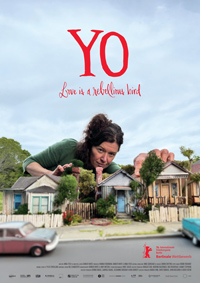 Watching something like Yo (Love is a Rebellious Bird) reifies the exceptional and unique nature of human connection and friendship, a tribute from directors Anna Fitch and Banker White for their deceased friend, Yolonda Shea. At the same time, it is a multi-layered documentary exercise so personally specific, it really only justifies itself as an exercise in catharsis for those who made it. Certainly, there’s a time and place for audiences to seek out and enjoy discovering remnants of this outspoken woman who lived life by her own rules, but ultimately, there’s something a bit too personal, a bit too detached, like we’re eavesdropping on a stranger’s home videos during an unexpected stretch of free time in a captive vacuum. Sure, its subject exemplifies the sometimes painful but ultimately beneficial experiences of seizing the day, but it’s also bordering on the banal.
Anna Fitch met seventy-three-year-old Swiss born Yolonda Shea when she was only twenty-four-years-old. The wry, independent older woman gravitated towards Anna, and the two became close friends throughout the corresponding decades. As Anna married, built a family, and became a filmmaker, she began a documentary project about her friend Yo. But when Yo died, Anna would spend the next decade figuring out a novel way to keep both the memory of Yo and the project itself alive.
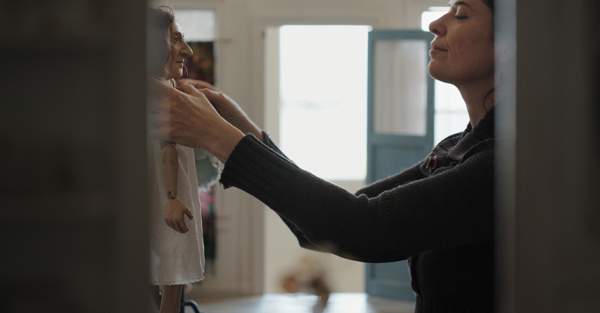
Married couple Anna Fitch and Banker White share co-directing credit, but it’s clear Yo was Anna’s friend, with Banker serving as the support system and co-architect of this decade long project which feels like a somewhat consuming way to let the processing of grief define one’s personal era. Fitch’s narration flits back and forth, examining the beginning of their friendship through the last year of Yo’s life. Perhaps as a way to visually narrate her own essence, Anna’s background as an entomologist, quite a disparity from Yo’s own pursuits as a young woman, yields various snippets of insects. If Yo is a vestige of the sacred, Anna herself is rooted in the natural world, perhaps the profane. Eventually, we get to the strangeness of this documentary exercise, which finds Anna and her family spending years building a 1/3 scale sized house and neighborhood of where Yo lived, a doll version of her friend utilized as a way to reenact flashbacks of Yo’s past. This includes some drastic changes, such as leaving behind a husband and three children to pursue a drifting odyssey whereby she would take a much younger lover.
Vast recordings of Yo during her final years finds the woman relaying various memories of her confrontations with religion, her tempestuous relationship with her father, and how she felt about sex. There are often fascinating, illuminating tidbits in these soundbites, ultimately showcasing what an interesting and unique person Yolonda was. But, by the end of the film, it’s unclear why this project would seem sublime to anyone other than those who were consumed by its creation.
A close comparison might be something like Jeff Malmberg’s 2010 doc Marwencol, but even this exercise, which finds its maker processing an attack which left him irreparably changed, justifies its existence and process as a way of reclaiming meaning through artistic endeavor. Yo (Love is a Rebellious Bird), at the end of the day, is about the need to let go. It’s difficult not to, somehow, confoundingly, turn to Madonna’s “The Power of Goodbye,” as a somehow more succinct response to how complete strangers might approach their own feelings towards Fitch and White’s exercise – “Learn to say goodbye.”
Reviewed on February 20th at the 2026 Berlin International Film Festival (76th edition) – Main Competition. 78 mins.
★★½/☆☆☆☆☆



 Movie Review: Visit IONCINEMA.com for more Documentary Film reviews & interviews!)