

Broken Heart Art: Kore-eda Builds Bittersweet Elegy to Friendship
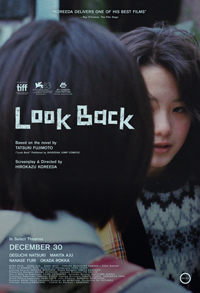 Art is both the impetus for destruction and creation in Hirokazu Kore-eda’s latest, Look Back, a live-action adaptation of the 2024 animated film of the same title (based on the manga series by Tatsuki Fujimoto). Kore-eda’s version adds an extra textual layer to this universe, which concerns two young girls who bond over their love of creating manga, who then go on to develop their own serial, which receives an anime adaptation. The emotional depth shifts a bit as well with this live-action version, feeling as if there’s less escape from a formidable tragedy which drastically alters the characters’ lives in the third act.
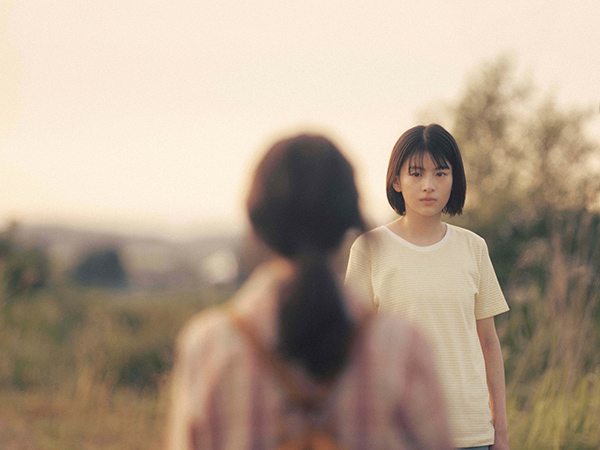
A star student in her fourth grade class, Fujino (Fuuri Nanase) seems poised for greatness thanks to her celebrated yonkama (a four celled manga) in her school paper. One day, her teacher asks if Fujino wouldn’t mind allowing another student, Kyomoto (Rokka Okada) to take up the space in the paper for a second yonkama. Apparently, Kyomoto is a recluse who is homeschooled and the administration believes her passion for manga might be a way to acclimatize with other students. Fujino agrees, but learns with dismay that Kyomoto is an expert background illustrator. Desperate not to be outdone, Fujino throws herself into bettering herself at illustrations, but to no avail, deciding instead to quit drawing manga due to her perceived limitations. At the end of the term, a chance encounter with Kyomoto reignites Fujino’s passion, and they become best friends. Throughout high school they become a collaborative team, and win a contest with their manga. While Kyomoto might be better at illustration, Fujino is a crackerjack with story and characterization. After high-school, they are given an opportunity to have their manga, Shark Kick, serialized, but Kyomoto decides she wants to go to art school, and Fujino feels abandoned by the decision. As Fujino finds success on her own, tragedy strikes at Kyomoto’s school when a jealous young man, who feels slighted by a world which finds him untalented at manga, commits mass murder with a pickaxe. Kyomoto is one of his several victims.
Look Back is the second title this year from the prolific Kore-eda, following his Cannes competition title Sheep in the Box, a genre tinged narrative much more labored in its attempts at profundity. His keen sense of gentleness in charting the sweetness accompanying new friendships or rekindled familial connections has always been evident in his films, and there’s often a sense of watching the clouds part to let the sunshine in, something he quite obviously uses as a metaphor in After the Storm (2016), one of his more underrated titles. Likewise, Kore-eda is exemplary when it comes to conveying the often tempestuous emotional landscapes of children, sometimes defined by dire circumstances, like in the classic Nobody Knows (2005) or the lovely, arguably more universal I Wish (2011).
But there’s often the menace of some disproportionately terrible peril at the periphery, and it’s difficult not to compare Look Back as the feminine version of his well-received Monster (2023), where two boys find their friendship questioned after a dramatic confrontation at school. Kore-eda follows the source material closely, even bleeding over into anime in an exceptionally integrated sequence, cascading across Fujino’s thoughts to the audience. Having edited many of his own features, Kore-eda’s less well acknowledged talents are undeniably evident in his latest, specifically with a third act marrying the catharsis of fantasy as a conduit to find the strength to move forward.
It’s Kore-eda’s first time working with DP Senzo Ueno, (whose work on Michihito Fuji’s 2020 title, The Brightest Roof in the Universe, also focuses on a young girl navigating love whilst mired in her passion for calligraphy), and there’s a crispness to these visuals mirroring a change of season, clued in by the migration of swans. The growing friendship and artistic symbiosis of the girls provides the impetus for most of the running time, and, sometimes to its detriment, there is a slight tweeness to the score from composer Yuta Bandoh (who also worked with Kore-eda on Sheep in the Box). One might desire the energy to get cranked up a notch or two, like an emotional prologue to something like Shinobu Yaguchi’s celebrated Swing Girls (2004).
But Kore-eda is a master of the unstated, this time around focused acutely on the sound design of creation, which almost seems to subconsciously cue a Pavlovian response with a myriad of pencils scratching paper and whops of moist paint stirring on canvases. Looking back is necessary to move forward – it’s just important not to get stuck there.
Reviewed on September 7th at the 2026 Venice Film Festival (83rd edition) – In Competition. 100 Minutes
★★★½/☆☆☆☆☆