

The Play’s the Thing: Ambrossi & Calvo Connect the Dots

“Dark love is the love that is never named,” wrote Federico Garcia Lorca in Sonnets of Dark Love whose unfinished manuscript of The Black Ball is the connective tissue between three gay men from three distinct periods – 1932, 1937, and 2017. A recuperation of the love that dare not speak its name is the central theme across these eras, charting the stymied progression of social acceptance regarding the queer community in Spain as a contemporary generation struggles to fill in the blank spaces left by systemic erasure. Directors Javier Amrbossi and Javier Calvo (whose previous feature was a musical comedy, Holy Camp!, 2017), mount an expansive historical saga built around bridging familial historical gaps by envisioning what it would be like to make Lorca’s final lost play intact.
In 1932, Carlos (Milo Quifes), at the urging of his father, who is respected in the community, is urged to join their local casino, run by homophobic elders who vote on his candidacy with white (for) and black (against) balls. Carlos is ‘black balled’ by the elders for the ‘open secret’ concerning his homosexuality. Only five years later in 1937, the country in the midst of the Spanish Civil War, a Nationalist soldier, Esteban (Guitarricadelfuente), displaced when Italian allies mistakenly bombed his village, finds himself assigned to guard a Red named Raul (Miguel Bernardeau) who has been captured, recuperating from wounds until he can be questioned and sentenced to death. The men share an attraction to one another, and Raul begs Esteban to keep a promise regarding an unpublished play. Then, in 2017 Madrid, ex-playwright cum historian, Alberto (Carlos Gonzalez), whilst working on his thesis, is told his maternal grandfather, who he thought was already long dead, has left him a secret inheritance. All three of these periods are connected by a long lost manuscript by Federico Garcia Lorca, La Bola Negra.

While The Black Ball coalesces effectively once it’s revealed just how these characters across these three periods are related, the running time of this saga does begin to lose momentum as it skitters back and forth. There are reasons why the 1932 segment with Carlos feel a bit neglected, but it’s also where the spirit of Lorca’s motifs reside, culminating in more universal profundity beyond the pale of war and trauma – we only have now, the moment we’re living, in to enjoy, even if pain is biting at our heels, or our mortality brandished in our faces. Similarly, the impaired relationship between Alberto and his mother Teresa ends up with a pat resolution, a mere bandaid for the real exploration they need to work through. This segment perhaps feels the most inconsequential, but features more jarring moments from unexpected spikes of anger and resentment, such as Duenas, coked out and drunk, tosses a glass at her son in a restaurant. Likewise, arguably in the opposite direction, are passages which feel more fitting in an adult telenovela, such as a minor character observing “the heart of a faggot is an ocean full of secrets.”
There are glittery moments of star power with Penelope Cruz as Nene Romero, an actor who entertains the troops with her troupe of women, pencil eyebrows and an attitude reminiscent of Marlene Dietrich (and a far cry from something another period piece like 2004’s Head in the Clouds, featuring Cruz). In the modern era we have Glenn Close on a book tour, a scholar on Lorca who gets her holy grail moment when she receives the manuscript of La Bola Negra. It’s perhaps mostly a novelty experiencing Close in Spanish (but a far cry from something like the bungled adaptation of Isabel Allende’s The House of the Spirits, 1993).
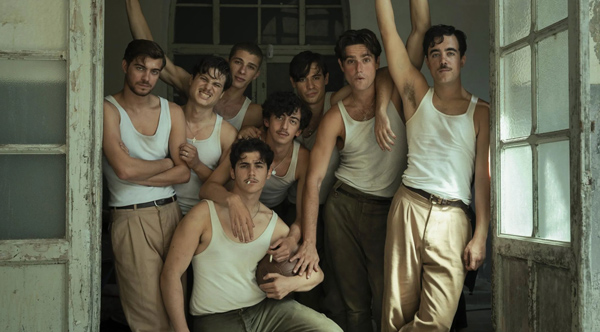
The wartime relationship between Esteban and Rafael, who end up in a kind of Kiss of the Spider Woman (1985) dynamic, are the film’s most emotionally potent moments, while Alberto and his partner (an underutilized Julio Torres) don’t ever get to share enough screen time, making theirs seem more a marriage of convenience. With segments spanning Granada, Cantabria, Santander, and, of course, Madrid, it’s a topographical and historical saga dialed down to intimate dimensions. In a world currently backsliding into chaos, The Black Ball reflects on the importance of authenticity as the legacy to be inherited. As Nene Romero tells Esteban, “Transvestism is the fantasy of possibility. War is the opposite.” The closet, in a collective sense, has been blown open wide, but we’ve hardly explored the generations of sediment still needing to be unearthed.
Reviewed on May 21st at the 2026 Cannes Film Festival (79th edition) – Competition. 159 Mins.
★★★½/☆☆☆☆☆