

The Child Inside: Lenz Explores the Virtues of Violence
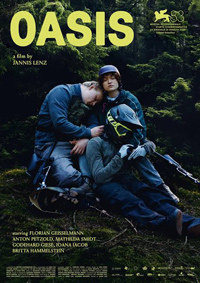 For his narrative feature debut Oasis, Jannis Lenz channels contemporary intergenerational neglect and the inherent apathy accompanying the rigid tenets of masculinity. It’s a narrative redolent of countless narratives dealing with the increasingly violent tendencies of a contemporary generation, though mass desensitization via social media has arguably created new mutations on the continuum of discord which tends to universally define the terrors and traumas of adolescence. It’s clear trouble lies ahead for the nubile protagonists from its opening frames, conjuring Santigold’s “Disparate Youth,” warning us (and them), “Don’t look ahead, there’s stormy weather.” A major through line of Lenz’s filmography, Ahmet Şimşek (who starred as version of himself in Soldat Ahmet, 2021) appears as a sort of motif regarding Lenz’s fluctuating explorations of how masculinity must constantly be navigated from an offensive or defensive standpoint in a world which simply doesn’t allow for vulnerability.
High school student Lukas (Florian Geißelmann) lives alone with his widowed father Martin (Godehard Giese), who works as a counselor at his school. Despite his father’s misgivings, Lukas spends most of his free time playing paintball in the woods with his friend Andrew (Anton Petzold). However, a viral video of Andrew climbing the school’s gym ropes while naked has circulated, making him a laughing stock and outcast. Though he’s been forbidden to do so, Lukas continues to disappear into the woods with Andrew and another close friend, Maya (Mathilda Smidt), who doesn’t attend the same school. Their games begin to take on more troubling dimensions, the act of pain they inflict on another acting as a release valve for the tension they cannot expiate at school. As Andrew begins to get into physical altercations with his bullies, the school officials initiate an anti-violence training program led by an instructor (Ahmet Şimşek) who makes the students engage in tense scenarios where they’re supposed to learn how to avoid violent reactions. However, more than a band aid is required to ameliorate the seeping social wounds.

Like many contemporary films dealing with adolescent ennui, social media is the disastrous and dramatic catalyst which seems to hasten the ruin of the teenagers who are victimized by its invasive potency. Despite the diplomatic (but ultimately bureaucratic) best intentions of the adults, the disconnect between determining what’s really going on between the toxic socializations of the student body appears to be wider than ever. But this sense of ‘going through the motions’ exemplified by self-absorbed adults is hardly unique to the modern era. Lenz’s tonality resembles a number of other provocateurs from his own backyard. Having been mentored by Jessica Hausner and working as an assistant to Michael Haneke, it’s impossible not to draw immediate connections with films like Benny’s Video (1992) or Funny Games (1997 and 2007). But Lenz channels another Austrian also beloved by Haneke, Pulitzer Prize winning author Elfriede Jelinek, whose 1980 novel Wonderful Wonderful Times similarly dealt with a group of disillusioned miscreants who commit heinous acts in the woods, unable to grapple with the 1950s post-war ennui of their traumatized parents (which was made into a 1982 television film, The Excluded).
Lenz favors more subtlety than his predecessors, and doesn’t wade quite so deeply in the vicious weeds. What’s interesting is how the adults who are presumably perfectly poised to be of some meaningful assistance end up being the most destructive, such as Lukas’ father, who is wary of his friendship with Andrew, though they’re probably the only real emotional support system either one has. Lukas, quite profoundly, has been secretly raiding his dead mother’s closet, cutting up her clothing for his own reconfigurations, a metaphorical attempt to create meaning of the past by chopping it up and making something new, something arguably his own. Another counselor advises Lukas regarding the troubled Andrew, “Sometimes the victim role is.a personal choice,” as if any teenager could somehow articulate such an actualized approach to how they’re responding to the onslaught of a hostile environment. Between the boys is Maya, who offers something of a fresh alternative with an ability to share her vulnerability, actually assuaging some of the tension between them, as well as intuitively disarming a potentially violent altercation in the third act.
In several ways, Oasis feels reminiscent of (and would make a great double feature with) Ilker Catak’s The Teachers’ Lounge (2023), which prizes the perspective of a well-intentioned teacher meddling with touchy scenarios involving a student. But really, Lenz’s film feels like prolegomenon to something more vitriolic, as evidenced by the final shot of Lukas, suggesting a development into scenarios like Gus Van Sant’s Elephant (2003), or, perhaps this year’s grueling Serbian film 3 Weeks After from Miroslav Terzic. Ultimately, there are reckonings on the horizon when the oasis dissipates.
Reviewed on September 6th at the 2026 Venice Film Festival (83rd edition) – Orizzonti. 118 Minutes.
★★★/☆☆☆☆☆