

You’ll (Dis)Like My Mother: Mengel Mars a Celebration
With his directorial debut The Guest, director Mads Mengel seems to have turned to the manifesto of the Dogme 95 film movement with a narrative purely utilizing the famed ‘vow of chastity’ rules as regards his unfussy narrative powered exclusively by characters and performances. Of course, this association is also cemented by a ferocious turn from Trine Dyrholm, who starred in perhaps the most agonizing but successful films from this Danish cycle, Thomas Vinterberg’s The Celebration (1998). From a filmmaking standpoint, Mengel isn’t doing anything uniquely innovative, but wholly succeeds in dropping us into a well-staged mire of familial dysfunction which remains captivating, even when it seems a reluctance to go to further extremes sometimes feels as if a more pronounced maelstrom might have benefitted the material.
In a quaint seaside hotel and casino in Marienlyst, Emilie (Mette Klakstein) and Karl (Simon Bennebjerg) are scheduled to christen their infant Elliot. When Karl’s sister Rikke (Josephine Park) arrives, chaos ensues when he learns she has invited their estranged mother, Vibeke (Dyrholm), with whom he hasn’t spoken in over a decade. Immediately, discomfort sets in when Vibeke arrives as it’s unclear whether or not she has been taking her medication for an unspecified mental illness. Karl tries to mitigate her behavior. But just all seems to be going well, the past resurfaces.
Initially, the arrival of the uninvited Vibeke at the infant’s christening carries with it the weight of the witchy Maleficent cursing the adulthood of Sleeping Beauty for not being invited to the party. But quickly this becomes a complicated dance dictated by anxious attachment styles her children continue to choreograph in their own lives. Dyrholm, whose character is nine years into finishing her thesis on Strindberg (the iconic playwright her new in-laws have never heard of, utilized to laughable effect) arguably feels like she’s fashioned herself into some modernized parallel to the works she’s been studying, an unstable force field whose breakdown could have easily been title The Mother as a reference point to Strindberg’s The Father (1887).
The audience is as equally on edge as the family Vibeke is accosting, and we’re left waiting for the inevitable mental health spasm(s) to occur, with Dyrholm navigating bipolar manic phases with aplomb. Dressed as a dowdy librarian, she exudes a confident power of superiority, and it seems part of her desires to save her estranged son from the pedestrian prison he’s willingly accepted, castigating his professional choice to ‘lease cars,’ a derision she gleefully employs. An early rambling story she shares about a strange man she hitchhiked with cues us (and them) to beware of the faulty narrator (i.e., herself).
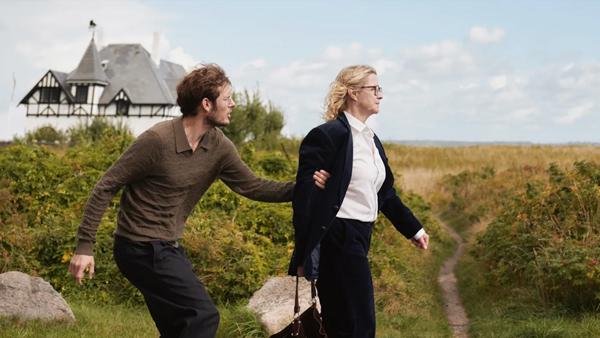
Mengel has several key moments of respite, breaks from the agony, which suggest Vibeke might have the opportunity to repair the damaged relationships with her children. Karl comes around to believing his mother’s intentions might be pure, which ends up being a fatal miscalculation. However, her treatment of Rikke really provides all the clues we need to determine catastrophe is right around the corner, and Josephine Pike’s performance rivals the richness of Dyrholm’s. Rikke’s sublimation lurks in nearly every interaction witnessed, from the dog she owns who believes she doesn’t like her to the girlfriend Emma she’s afraid to be intimate with, her thin veneer of control is an act, purely artificial.
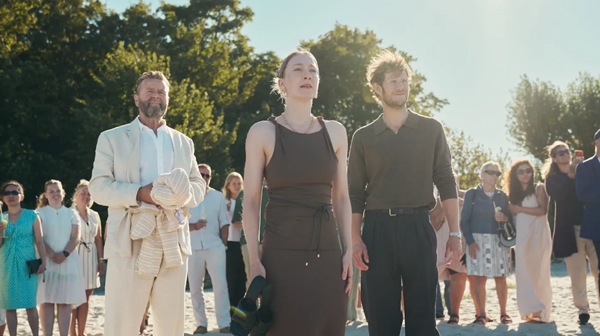
Akin to the Dogme 95 films, DP David Bauer favors chaotic close-ups as the intensity ratchets up between key players, arguably a technique which now seems primed for comedic effect. But Mengel maintains an uncomfortable sense of realism which allows The Guest to remain tense, sometimes cloying—-this is an event which befits an Irish goodbye, its disillusioned characters courting ire and disdain for their weakness in handling a situation which, from afar, should be manageable. But maybe the greatest catch of discomfort is realizing how any of us would likely be unable to behave much differently.
Reviewed on July 6th at the 2026 Karlovy Vary Int. Film Festival (60th edition) – Crystal Globe Competition.. 100 Mins
★★★/☆☆☆☆☆