
Celestial Orgy: Haroun Ain’t Afraid of No Ghosts
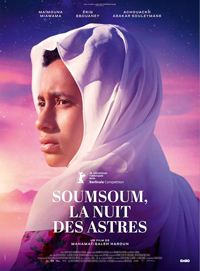 Nestled deep down inside the core of Soumsoum, the Night of the Stars is a compelling narrative worthy of the pristine cinematography of DP Mathieu Giombini and the striking beauty of actor Maïmouna Miawama, making her debut. But the latest title from Chadian auteur Mahamat-Saleh Haroun is unfortunately a misfire as a glacially paced ghost story which can never quite unify the ersatz supernatural visions of its protagonist with the claustrophobic politics of the stifling village somewhere in the Ennedi Desert. A lusciously photographed narrative slog, it’s a surprising misfire from the director following 2021’s Lingui, the Sacred Bonds, especially as he once again returns to a mystical, femme-centered fable.
Haroun has often deconstructed genre mechanisms in his narratives to accent significant social unrest or historical periods from his country, such as with earlier masterworks Dry Season (2006) or A Screaming Man (2010). Initially, Soumsoum appears to tread similar territory, a framed narrative set in a specific period in 2024 when a deluge significantly transfigured the village. An elder tells seventeen-year-old Kellou (Miawama), our heroine, there has not been such an influx of water since a previous event called the Rain of Abundance. Slowly, we learn Kellou is somewhat of an outsider in the village, daughter of Garba (Eriq Ebouaney, of Haroun’s 2017 title A Season In France), a foreigner with a murky past. Kellou’s mother died while giving birth to her, and stepmother Aicha is one of many who remind the teenager she is a ‘child of blood.’ Just as infants around the village begin to mysteriously die, Kellou begins to see visions, seemingly from both the past and present. When the village leaders accuse Aya (Achouackh Abakar Souleymane), a woman who had recently returned from afar, of being the cause of the new curse inflicted on the community, she is introduced to Kellou, and senses her affliction of visions. Suffering from ill health, Aya confirms she was the midwife who delivered her, confirming details about the mother Kellou had never known. Their relationship will transform how Kellou sees herself and interacts with the world around her.
What hobbles Soumsoum considerably is how it fails to weave these almost Stephen King-like supernatural elements of a psychic teenager into the emotional narrative elements about a young woman who’s really just needing to buck the negative associations defining her. The strange happenings in the village fall to the wayside as we get wrapped up in the drama of Aya, who diverts us down a tangential path of her own origins, a child who was born following a now abandoned village ritual called the ‘soumsoum’ or a ‘night of the stars.’ Basically, this was a masquerade ball event where disguised citizens had an orgy, and nine months later, no one could tell who sired the children born from this event (and thus, potentially have mystical associations). Aya doesn’t seem to be able to do much, but she imparts some sage advice upon Kellou, which basically amounts to the golden rule – treat everything around you with benevolence because everything alive in this world is connected.
Another subplot involving a young man named Baba, who is romancing Kellou but betrothed to his cousin, adds some additional drama when a break-up leads to one of several dramatic moments from a young woman whose behavior seems to increasingly reflect her age rather than supernatural intervention. Much of the dialogue consists of characters shouting her name endlessly, which suggests Kellou might have been the more appropriate title. Ultimately, Soumsoum, the Night of the Stars feels stitched together haphazardly, and somewhat of a disappointment from the usually pristine Haroun.
Reviewed on February 19th at the 2026 Berlin International Film Festival (76th edition) – Main Competition. 101 mins.
★★/☆☆☆☆☆