

Bent Knee, Limp Wrist: Dhont Explores Love at the Frontline
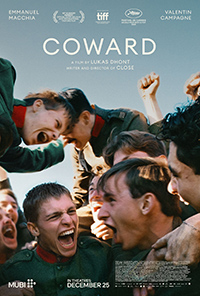 “We have so much to say and we shall never say it,” is one of the many grim rationalizations in Erich Maria Remarque’s classic anti-war text All Quiet on the Western Front, obviously one of the most aggressively loathed novels by Nazi Germany, where it was burned, banned, eradicated. Belgian director Lukas Dhont turns to the same period in an attempt to recuperate some of those things left unsaid from the perspectives of young gay men who served on the frontline. What might look like, on the surface, to be a familiar exercise about the horrific experiences of wartime on young men, historically, who were offered up as sacrifices, it is actually one of the few films centering queer characters as protagonists on the battlefront. It isn’t something which should be revolutionary, and yet, here we are.
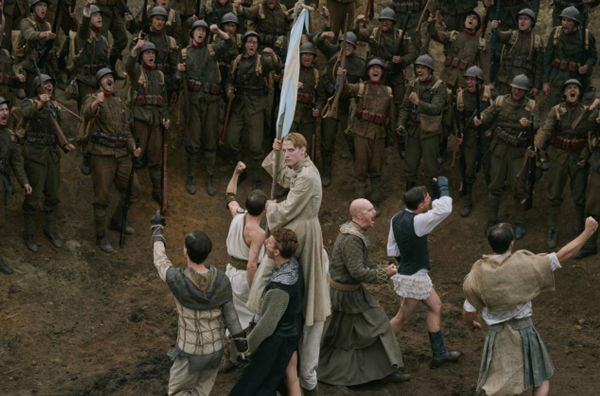
Pierre (Emmanuel Macchia) is a reserved (and notably, quite tall) young man sent to the Belgian frontlines of WWI. Spirits are high amongst his peers as they bond while being trained for their eventual time in the trenches. But there is also a group of men, labeled the ‘band of rejects,’ who, for various reasons, are deemed unfit for the fighting. Sometimes this is due to injury and recuperation, etc. The flamboyant Francis (Valentin Campagne), who seems to be the ringleader of this group, takes an immediate liking to Pierre, who he asks to help paint and build a stage for the purpose of entertainment during downtime. Much like the Elizabethan era, this requires men to utilize the art of drag to perform the roles of women characters. Eventually, Pierre becomes swept up in Francis, whose zest for living is infectious.
Curiously, it was learning about and researching the makeshift theatrical productions staged along the frontline inspiring Dhont and his screenwriter Angelo Tijssens, and there is certainly a hearty meticulousness in the details. While this is a narrative palette stretched across a larger scale compared to his last features, there are thematic similarities Dhont returns to once again, exploring how individuals break free from the restraints of their environment, which they are sometimes complicit in choosing. Often, he’s also exploring the parameters and moments of emotional permissiveness in homosocial surroundings, where there is a semblance of ‘privacy’ in a public, communal space.
With both 2018’s Girl (2018) and 2022’s Close (read review), Dhont finds his characters in transitions, processing attitudes towards them as tragic events tend to hasten their emotional development. He doesn’t take this to such extravagant extremes on the battlefront, but these are the strenuous moments which immediately send traumatic shock waves through the men. Eventually, Pierre’s desires and intentions take shape and the narrative begins to winnow further into the development of his relationship with Francis. Dhont resists expectations by exploring the contradictory natures of both men, as it’s the extroverted Francis who seems reluctant to follow the suggestions of Pierre, who wishes to desert. The scant details we receive about their pasts are expectedly grim, particularly for Pierre, whose father is the employer his mother works for. His abandonment issues convey the level of intensity he’s capable of once he finally lets someone in, which makes Francis’ reluctance all the more disappointing. In this time and place it would take someone willing to throw away all commitments and abandon the need for social convention to pursue their own happiness as a queer person. Arguably, in many places, this is still the case.
The second half of the film tends to get lost in this tug of war between the two leads with newcomer Emmanuel Macchia balancing the narrative almost entirely on his shoulders. Strangely, Coward sometimes feels like a mixture of two Oliver Hermanus films, 2019’s Moffie, and 2025’s The Sound of Music, queer military experiences blended with two men whose love is only made possible within the parameters of a specific opportunity on the road.
As far as war films go, Dhont brings his unfussy approach to highlight the humanity of his characters, and there’s an almost unexpectedly suspicious warmth, which recalls something like the 1992 film A Midnight Clear. Even a somewhat audacious introduction to Francis’ personality, whereby he pretends to be giving birth amidst the raucous cheers of his comrades, is presented as a moment of unity and revelry, unlike, say, a similar queer scene in Liliana Cavani’s The Skin (1981), where a man pretending to give birth happens as a violent, sleazy, Babylonian environment swirls around him in a fevered orgy. Most powerfully, Dhont stages a recuperation of queer representation as both resilient and hopeful. Happiness, or perhaps more importantly, contentment, is possible when you seek it and seize it.
Reviewed on May 21st at the 2026 Cannes Film Festival (79th edition) – Competition. 125 Mins.
★★★½/☆☆☆☆☆