

No Man’s Land: Women Wage Resistance in Ishaq’s Wartime Debut
Yemenis director Sara Ishaq approaches an examination of life during wartime in her native country for the first time as a narrative feature in The Station. An opening statement declares the events in this film are “depicting a parallel world caught in an endless cycle of fighting,” wherein the women left behind bear the burden of keeping everything together. Out of context, this suggests science-fiction or metaphorical detachment from the subject, but Ishaq’s choice to invent the rival gangs and locations somehow collapses universality and specificity. Warped fictions have collided and replaced a sense of normalized, stable reality, and suggests a futility in depending upon anyone or anything to quell endless cycles of violent conflict. At its heart, this is a narrative of resistance as a pair of sisters work together to save their youngest brother from enlistment.
Layal (Manal Al-Mulaiki) runs a women-only gas station in war-torn Yemen, providing a safe space for women to congregate and commiserate. The station exists in an area controlled by a gang known as the Sanadeed, and her choice to remain there has forced an estrangement with her sister, Shams (Abeer Mohammed), who lives several kilometers away. Their youngest brother, Laith (Rashad Khaled), lives with Layal, but has reached an age requiring his enlistment. Since Layal does not have enough money to pay the exorbitant fee to keep Laith away from the battlefront, she is forced to call on Shams for help. Together, they find a way to put aside their differences to save him.
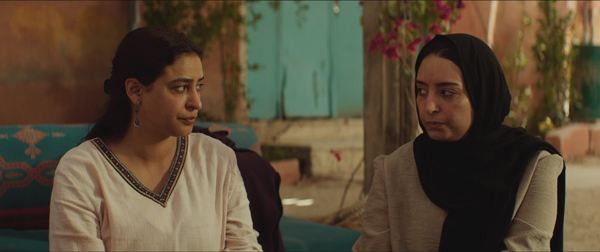
In many ways, the titular women-only station represents a similar safe-haven to various other loopholes for agency within a heteropatriarchy. It is an oasis similar to the brothel, the convent, the boarding school—operational structures technically controlled by women with a tacit agreement regarding the absence of men. The signage at the door declares “No Men. No Weapons. No Politics.” Eerily, the absence of these items and ideologies also represents their presence, because the women’s day-to-day lives are still controlled by how men wield their toxic dependence on weapons and political subterfuge.
Like an embattled border fortress, there is constant threat of unpredictable chaos, alleviated only by day-to-day routine, including the rationing of increasingly sacred petrol. But this sanctuary is also a trap, as the women are forced to police themselves, allowing the main villain to blossom into the supremely unhappy Abdallah (Shorooq Mohammed), the impetus for the dramatic catalyst who points out Laith’s coming-of-age. But as vile as Abdallah is, she’s also a victim of circumstance, her own miserable child the subject of increasingly physical and sexual abuse at the hands of the other boys, generating the brutality which always turns victim into victimizer.
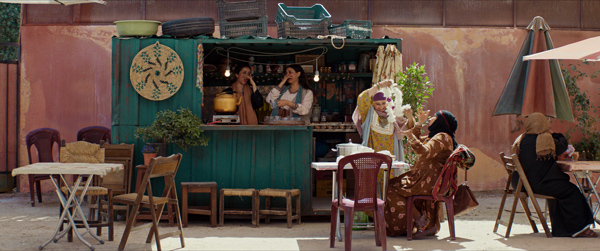
But the focus eventually becomes the reunion between two sisters and their critiques of one another, each choosing to survive in their own way. Layal has, perhaps unwisely, settled into a routine in the ‘controlled zone,’ at least until it becomes absolutely untenable. Shams, by default, feels customarily more revolutionary in her attitudes and beliefs. Ishaq pairs Shams with Ahmad (Saleh Al-marshahi) an adolescent boy who is supposedly her chaperone. However, this additional characterization tends to distend the film’s pacing, ultimately distracting from the core relationship holding the film together.
The Station is an interesting departure from Ishaq’s previous examinations of Yemen through documentary form, including her Academy Award nominated Best Documentary Short “Karama Has No Walls” (2012), and her documented return to her childhood home in 2013’s The Mulberry House. Reminiscent of Afghan filmmaker Shahrbanoo Sadat’s No Good Men (2026) with some variation on narratives (usually masculine, such as works by Joseph Conrad or Dino Buzzati) focused on homogenous groups held in indefinite suspension of conflict to come, Ishaq’s exploration is sometimes muted by it’s earnestness, perhaps predictably arriving at a foregone conclusion about survival being boiled down to the possibility of living tomorrow if one doesn’t die today.
Reviewed on May 17th at the 2026 Cannes Film Festival (79th edition) – Critics’ Week. 112 Mins.
★★½/☆☆☆☆☆



 Movie Review: Visit IONCINEMA.com for more 2026 Cannes Film Festival reviews, news & interviews!)