

She Who Is Not: Harari Explores Existential Identity Issues in the Body Swap
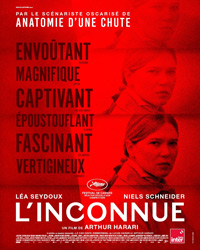 “A woman, for me, must remain a woman,” stated Andrey Tarkovsky when once asked what he thought about women, proposing their innate femininity and weakness as their only uniquely defining qualities. Such attitudes have arguably been apparent in the limited characterizations the Russian auteur presented in his filmography, most often as archetypes interpreted as misogynistic and from a blatantly heteronormative worldview. In comparison, there’s something quite intriguing in The Unknown, the third film from writer/director Arthur Harari, which is reminiscent of Tarkovsky’s predilections with displacement while also exploring dimensions which are at odds with the natural world as it concerns a (probably) malevolent entity which displaces one’s essence through a colonization or possession of their body. In short, it’s an arthouse body swap exercise with surprisingly existential and emotional depth, and quietly exists in a realm of uncomfortable explorations where spiritual and mental identities are at irrevocable odds with the physical.
David Zimmerman (Niels Schneider) is a depressed Parisian photographer, coaxed by his friends into going to a party. A reveler gives him a pill to loosen up, which leads to an encounter with a mysterious woman (Léa Seydoux) David randomly happened to photograph previously. The two of them have passionate sex in a quiet room somewhere at the party. When David awakens, he is now inhabiting the body of the woman, who he learns is Eva, a woman from Germany. Luckily, David has access to both their apartments, and circumstances lead him to locate his old body. It would seem there is an opportunity to swap back. However, David’s body is now occupied by a young woman named Malia (Lilith Grasmug), and it becomes clear there’s some kind of entity which hops bodies through sexual intercourse. Together, the two of them try to find a solution.
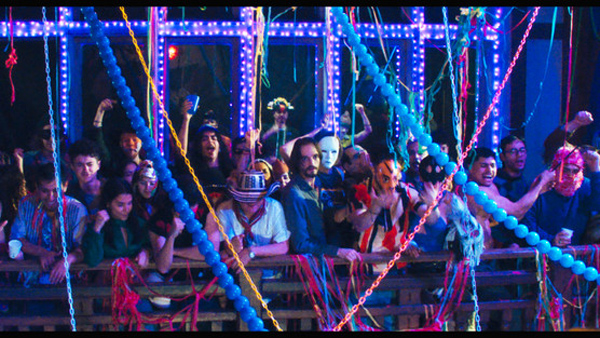
Based on the 2024 graphic novel Le cas David Zimmerman by Arthur and his brother Lucas Harari (while their brother Tom serves as cinematographer), the film is heavily dependent on the emotional reservoir of Léa Seydoux to navigate this mostly dialogue-free endeavor. Seydoux, who was also called upon to shoulder a similar otherworldly crisis in Bertrand Bonello’s 2024 masterpiece The Beast, arrives on the scene like a snarling Tarkovsky tigress, mounting Niels Schneider in the backroom of a masquerade themed party while he’s high on the kind of pill someone like Lewis Caroll would prescribe. Composer Andrea Poggio (who also scored Harari’s Onoda: 10,000 Nights in the Jungle, 2021, also examining a protagonist imprisoned within an indefinite limbo) utilizes a repetitive theme which might arguably feel oppressive but also assists in the essence of inescapable ennui and desolation. It’s an unappealing film to gaze upon, an eternal displacement magnified by Sisyphean impossibilities.
Cramped hovels and glaringly lit cafes highlight a motif of dissipating beauty, stability, and normalcy via David’s photography whereby he retakes photos from postcards of the 1920s and 1930s from the same vantage point to visualize shifting objects and structures ‘to show what has disappeared.’ There’s a sense of industrialized decay and stolen identity reminiscent of Antonioni, and even the desperate attempts of demanding meaning through cyclical repetition, as in Resnais’ Je t’aime, Je t’aime (1968). There are also thematic parallels to Kieslowski’s The Double Life of Veronique (1991), but sans the kind of comfort provided by DP Slawomir Idziak’s exquisite framing of Irene Jacob’s dual identities. These are bodies who are ravaged by the experiences they’re undergoing.
The meat of the narrative is the flotsam and jetsam of genre, like the hetero STI horror of It Follows (2014) from David Robert Mitchell, and, by extension, the OG David Cronenberg debut Shivers (aka They Came From Within), 1975. The anguish caused by the unknown entity, however, feels more akin to the underrated Jack Sholder film The Hidden (1987), where a body hopping parasite turns all those it inhabits into raging assholes. Harari marries these B-movie tropes with a profound angst, exploring human shells inhabited by alien essences, which aligns Seydoux with something like the Scarlet Johansson extraterrestrial in Jonathan Glazer’s Under the Skin (2013).
By default, the gender swapping takes on Kafkaesque dimension (physical possibilities brought to fucked up procreative conclusions). Initially, before we’re led to understand what’s really happening, when Eva’s body is inhabited by the masculine life force of David, Seydoux is left to fantasize about doppelgänger sex, the interior spirit attracted to the outer shell he’s inhabiting, which brings to mind the two Bette Davis twin vehicles, Dead Ringer (1963), and more aptly (at least in title), A Stolen Life (1946).
Niels Schneider (who resembles Robert Pattinson a bit here) eventually returns, inhabited by the spirit of an angsty teen girl (Lilith Grasmug). It’s fascinating to watch Seydoux and Schneider engaged in enacting the gender norms dictated by an interior personality at odds with the exterior. Tragedy defines the third act, as Malia attempts to make her way to her sister’s destination wedding, fantasizing about the attempt to explain to her father (an intriguingly cast Radu Jude) how she’s trapped in a strange man’s body. It’s a sequence which also exemplifies why The Unknown is justifiably slight on dialogue. The realistic dimensions of such a scenario can’t be easily articulated as anything more than ludicrous (which is why body swapping has become a classic comedic trope always denied the resulting body horror effort, outside of vulgar innuendo).
Universal themes regarding the inability to control one’s body allows for a spectrum of relatable experience with such an exaggerated scenario, and it’s alarming and uncomfortable to sit in this space with these characters. There’s perhaps nothing more sublimely staged than a sex scene, born out of desperation and a need for physical connection, when David (in Eva’s body) allows themselves to be penetrated by Malia (in David’s body). The outside and the inside have merged in the most intense way possible, navigated by Seydoux as she engages with fluctuating emotions ranging from despair to eventual intimacy. The Unknown traverses lost spaces, disappeared landscapes, and the inherent possibilities of reinvention (a la something like Kurt Vonnegut’s Who Am I This Time?). There is sex, there is pain, and there is life – all portals which lead us into some kind of unknown.
Reviewed on May 18th at the 2026 Cannes Film Festival (79th edition) – Competition. 137 Mins
★★★★★/☆☆☆☆☆



 Movie Review: Visit IONCINEMA.com for more 2026 Cannes Film Festival reviews, news & interviews!)