

Up Close & Personal: Sadat Subverts the Spotlight in Stellar Melodrama
 In her third directorial feature, No Good Men, which is part of a five film cycle with co-scribe Anwar Hashimi, Shahrbanoo Sadat creates something of an anomaly with a potent period piece which also exists on a rom-com continuum. The result is certainly a novelty in Afghan cinema, and moments of feminist centered levity feel heightened and empowered by the drastic political shifts about to consume its characters. Set in early 2021, on the eve of the Taliban’s return to power due to the withdrawal of US troops, the hard won respect of an outspoken, recently single camerawoman is about to be erased, though daily domestic issues make it difficult to glance too far ahead into the future. Sadat casts herself in the lead, who, on top of proving her adroitness behind the camera, happens to be a captivating and enigmatic screen presence.
Naru (Sadat) works as a camerawoman for a fluffy talk show at Kabul News, the city’s premiere news station. She’s fed up with the ridiculous nature of the show, which involves unhappy, abused women calling in for advice only to be told by a physician in residence they need to make themselves more appealing to their cheating spouse to maintain his interest. Naru is separated from her own husband, Samir (Masihullah Tajzai), an adulterer who is the father of their three-year-old son Liam. She’s left him, living with her parents in their cramped apartment. This arrangement is tenuous as Afghan law favors the rights of the husband, of course. When an opportunity arises for her to be taken seriously, her tenacity reveals itself when demanding to accompany Qodrat (Anwar Hashimi), the station’s most noted journalist, to interview a member of the Taliban in early 2021. Unfortunately, she’s utilized a scapegoat by the interviewee to halt the transmission. While Qodrat initially tries to punish her with a demeaning task, Naru proves the importance of representation while gathering candid news footage of women on the street. Circumstances lead her to become a temporary camerawoman for Qodrat, and their camaraderie turns to longing. However, Qodrat is also married, albeit in an arranged relationship with his cousin. Naru remains unconvinced Qodrat is different from any other Afghan man she’s ever met. Until…
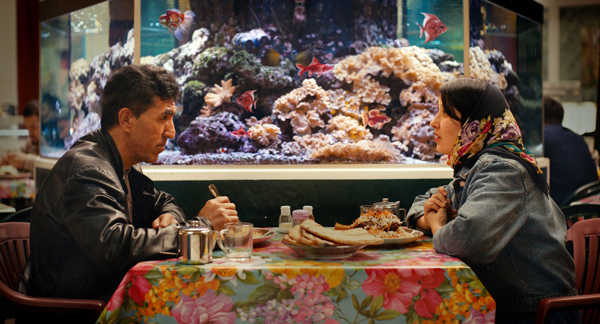
We’ve seen countless examples of women in the media struggling to prove their worth in a male dominated profession, though Naru’s plight to be taken seriously is at such an unprecedented and rudimentary stage it might read like a depressing anachronism to many Western eyes. Considering the political maelstrom serving as the backdrop for the central romance, Sadat’s film feels like a mash-up between The Year of Living Dangerously (1982) meets Up Close & Personal (1996), though it’s both sweeter and more serious than those comparisons.
Sadat leads us into uncharted territory quite carefully, but there are moments in No Good Deed feeling significantly subversive, such as when Anita (Torkan Omari), an Afghan expat and US citizen, brings Naru a vibrating dildo as an impending divorce gift. But it’s a rare moment of potential empowerment amidst a variety of constant reminders regarding women’s intergenerational experiences. Filming women on the streets of Kabul for some Valentine’s Day vox pops, Naru collects some unvarnished sentiments, such as an elderly woman who calmly relates her less than cheerful married experiences with “My life has become ashes.”
Sadat sets the scene with details which could easily feel like a normalized miserabilism, but Naru’s exceptional combativeness overrides a sense of despair. Her work ethic wins over the initially dismissive Qodrat, with Hashimi deftly becoming a surprisingly debonair and entirely romantic figure in Naru’s life. Romance, despite the rough terrain around them, blossoms as fiercely as the montage of flowers in the opening credits, and the impending doom of wartime builds their crescendo to something of a swoon.
Hashimi, who has co-scribed Sadat’s previous films, based on his own writings, has also slowly moved into something of a central figure in her directorial output. Previously having appeared in her 2019 feature The Orphanage (read review), their latest endeavor straddles a gender binary akin to the metaphorical subtexts of 2016’s Wolf and Sheep, here associating lions and flowers as stand-ins for men and women. A meaningful conversation between Layla (Fatima Hassani), Anita, and Naru suggests Afghan men cannot help their behavior, as they’re merely traumatized beings who have been conditioned into their misogyny. But Naru balks at agreeing with such excuses. Why are the women expected to absorb, internalize, and submit to physical and mental abuse? And for how long? What’s perhaps most upsetting about No Good Men is its formatting of a less than perfect but potentially ripe era of progression in Afghanistan so abruptly halted. Sadat builds to the memorable crescendo of flight from Kabul as the Taliban quickly swarms the capital. And like the opening moments of the film, Sadat bursts into a brief but powerful bloom with a moment as romantic as it is anguished.
Reviewed on February 12th at the 2026 Berlin International Film Festival (76th edition) – Berlinale Special — Out of Competition. 103 mins.
★★★½/☆☆☆☆☆