

Uncanny Valley: Mungiu Explores Liberated Prisons
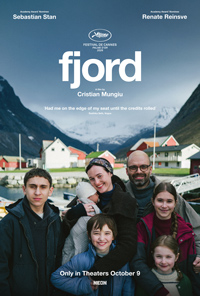 Totalitarian mentality is driven to logical extremes in Fjord, Romanian auteur Cristian Mungiu’s first foray outside of his native country, named for the deep, underwater valleys formed by glaciers common to the geography of Norway. As Mungiu is wont to do, he’s once again excavating the attitudes and anxieties hidden beneath the surface, as the title implies, returning once again to religion as impetus for cultural turmoil (as he did prior with his 2012 masterpiece Beyond the Hills). In an increasingly topsy turvy world, notions of victims and villains have become less delineated, which might explain why the agonizing ethical dilemma he’s dissecting takes on the pallor of a dark comedy more than ever before. Reuniting Sebastian Stan and Renate Reinsve (who recently starred in Aaron Schimberg’s A Different Man, 2024) as a couple who recently immigrated to the latter’s native country after having previously lived in Romania, they find themselves, unexpectedly, at the center of a witch hunt.
Mihai and Lisbet Gheorghiu (Stan and Reinsve) have left Romania to settle in a quant Norwegian town where he has taken on an IT position, which he is overqualified for as an engineer. They have five children, which includes an infant, and observe a strict Christian doctrine to raise them. Their eldest kids, Emmanuel (Jonathan Ciprian Breazu) and Elia (Vanessa Ceban) have entered adolescence, and are close enough in age to court the same friend group. Everything about their new move seems copacetic in a politely saccharine sort of way, but the community at large feels put off by their religious views. When Elia shows up with bruises at school, Child Protective Services are called in and the children are removed. Mihai and Lisbet admit to employing light corporal punishment, and so begins an arduous legal battle to keep custody of their children and avoid jail time.
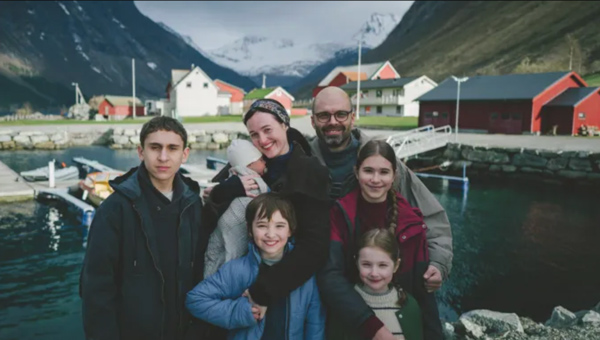
“Until an hour before the Devil fell, God thought him beautiful in heaven,” Arthur Miller wrote in The Crucible, his dramatic reckoning with the Salem Witch Trials, wherein ‘common vengeance writes the law’ as neighbors violently persecute one another in the name of their God. Mungiu presents a different scenario where the religion itself faces persecution, sanctimonious beliefs are doggedly lambasted, but under the guise of suspected child abuse, and the generously liberal, progressive laws of Norway become dangerous tools. It’s a classic example of how easily systems can be manipulated based on who’s in control of them, and how tools and methods humans use for survival eventually can hold them back. The problem with any kind of extremism in either direction ends up circling back to the same vantage point, which is why liberalism can easily adopt the same rigid tendencies of fascism. Mungiu’s film plays like a less hysterical version of Thomas Vinterberg’s The Hunt (2012), where Mads Mikkelsen finds himself accused of pedophilia. When there’s blood in the water, a frenzy commences.
What’s perhaps most fascinating about Fjord, in comparison to Mungiu’s previous films, is a murky line of demarcation. Previously, his protagonists were figures destined for obliteration by an unyielding system determined to oppress anything not sanctioned outside of specific, standardized cultural norms. Most often these are women struggling to obtain some sense of agency, routinely and aggressively punished for trying to do so. The Gheorgius are the victimized entity, and yet, they are also part of the problem, and Mungiu takes pains to consistently showcase how conservative religious beliefs tend to usurp space, often innocently. But the road to hell is paved with good intentions.
Still, their punishment by a system determined to be so progressive it’s become farcical in its rigidity and bureaucracy is an exaggeration which makes Mungiu’s latest feel purely satirical. The Norwegian flag billows ominously in the window as Lisbet is informed her children are to be removed from the home indefinitely. Resistance is futile, even dangerous. The delirious oppressor is the unchecked power of Child Protective Services (which is a bit like the EPA being the dastardly culprit in Ghostbusters, 1984). As Mungiu slides into an extended courtroom legal battle, CPS representative Gunda (who is notably childless) allows Ellen Dorrit Peterson (a favorite of Joachim Trier) to take on the smug, exactingly clinical evil last donned by Louise Fletcher as Nurse Ratchet. Sebastian Stan, who is actually Romanian, tends to distract, if mostly for a bald pate which seems an effort to make him seem merely an obsequious, self-righteous family man swept away partially due to his own frustrating obliviousness. Better served is Renate Reinsve, stoically shouldering the cruelty of having her infant yanked from her breast whilst her remaining children are dispersed across the countryside.
Where Fjord tends to suffer is through the English language interactions with the children, their dialogue often feeling unnatural. The troublesome neighbor girl Noora (Henrikke Lund Olsen, who develops an obsession with Elia (whose pious constraint apparently is an exotic attraction in world where permission is taken for granted), promises to verge on the sociopathic strand of Fantine Harduin in Haneke’s Happy End (2017), but Mungiu restrains himself from any gross atrocities. Fjord is a battle of wills, ostensibly, but reflects the constantly shifting force of favored ideations. Whoever is in control dictates appropriate behavior, and eventually everything is cannibalized, then repackaged, and someone continues to live another day to push a rock up an endless hill.
Reviewed on May 18th at the 2026 Cannes Film Festival (79th edition) – Competition. 146 Mins
★★★½/☆☆☆☆☆