
The Story of O: Schoenbrun Approaches the Horrific Desire Inside Us All
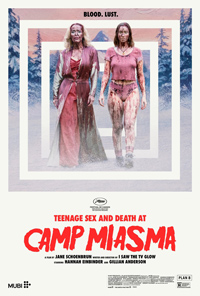 The inextricable union of victim, victimizer, and witness becomes a metatextual balancing act in Jane Schoenbrun’s formidable third film Teenage Sex and Death at Camp Miasma, a gonzo pop art slice of catharsis which works as both a recovery and discovery of the queer gaze in horror cinema. Effortlessly droll in its satirization of the academic approach in our contemporary retrospective drive to cannibalize but correct the formative inspirations of the past as a means to satisfy the demands of an arguably more enlightened generation, there’s a delirious amount of analysis pulsating through every passage. Making good on the formidable promise shown in their low-fi 2021 debut We’re All Going to the World’s Fair and the complex enigmas in I Saw the TV Glow (2024), it’s difficult to point to any other recent cinematic grapplings which so enchantingly elevate what’s long been dismissed as low brow to the heights of such a stridently sacred altar.
A franchise known as Camp Miasma, a successor to the Friday the 13th series featuring an unassailable serial killer known as Little Death (Jack Haven), was run into the ground decades ago. The cult classic series featured transphobic, exploitation elements but has recently been revived with renowned queer indie filmmaker Kris (Hannah Einbinder, “Hacks”) at the helm. Tasked with revitalizing the franchise by creating a new, revisionist origin story to excise the problematic originator, Kris approaches the breakout star of the first film, the reclusive Billy Presley (Gillian Anderson). Meeting at the cult icon’s wintry abode in the Pacific Northwest (which just so happens to be the actual campsite of the first film), a bizarre commiseration unfolds. Billy is unimpressed with Kris’ academic approach, claiming the basis of the original was all about ‘flesh and fluids.’ Slowly, Kris is led by Billy to articulate her own neglected sexual desires.

In their deliberation on our collective relationship(s) with the moving image, Schoenbrun speaks to a fascinating realm of possibility, an argument which counters a perceived and inherent detachment. Arcade Fire’s 2007 title track from the album Black Mirror asserts “Shot by a security camera/You can’t watch your own image/And also look yourself in the eye.” But perhaps this is, and always has been, a conclusion which limits how we can utilize the tangible as a tool to tap into our own (necessary) existential realm, a parallel experience uniting the associative and dissociative. In other words, Teenage Sex and Death at Camp Miasma suggests that the opening of ‘the third eye’ requires the unification of extremes, high and low, as a way to expand our dimensions. Horror as a genre has always represented a key to our primordial bases as it promises the necessary equalization of fear and desire for the experiencing of our ultimate goal, the orgasm.

It’s, of course, no mistake the immortal serial killer of the Camp Miasma franchise is called Little Death, because ultimately they are representative of the climax, the pinnacle of our id. Schoenbrun collapses the Friday the 13th and Sleepaway Camp series as a way to unify sexual spectrums, always the defining, underlying aspect peering into our subconscious as we consume these narratives (a shout out to Ed Gein also speaks to our awareness of how our fascination extends to their real world inspirations). Another level of the Little Death character (also reduced to being named the Air Vent Man) is the Hellraiser/Cube headdress work by Jack Haven of I Saw the TV Glow. Little Death’s perspective is also reminiscent of the camera obscura, an evolution of the processing of drawing and photography. All of these elements suggest the stepping stones to our own individual enlightenment have already found us.
The level of detail applied to Schoenbrun’s world building is evident in the opening credits, an assorted scrapbook of details filling us in on the Camp Miasma world, its participants, and newly appointed spiritual guides. Hannah Einbinder’s Kris is our psychopomp into this resurrection, requiring she return to another nexus of extremes, the ‘first’ ‘final’ girl, an intriguingly named Billy Presley, a moniker which blazes with rock and roll icons of her heyday. A deliciously styled Gillian Anderson, marvelously thriving in the abandoned camp site utilized in the first Camp Miasma film, creeps out of the shadows like the creature she is, a remnant from a past world.
References to Norma Desmond abound, but Anderson also comes across like the wicked, vamp version of Dolly Parton. Movie memorabilia adorns her midst, including poster art which, like Tarantino, lifts from real world artifacts, such as 1981’s The Burning (co-written by Harvey Weinstein, one of the countless monsters in the shadows). Billy rolls a joint, explaining her own difficulties with sex were overcome with a little assistance (though it sounds like they’re both just waiting for someone to offer them ketamine). Boundaries are blurred, but Schoenbrun isn’t so much interested in moralizing rather than getting at innate truths hidden beneath approaches deemed either problematic or politically correct.
At its core, Schoenbrun doesn’t hold any punches, as critical of the magic lost in intellectualization during the present as the problematic exploitations of the past. Kris, who seems unhappily partnered in a polyamorous relationship with Mari (Jasmin Savoy Brown) thanks to the involvement of a bisexual caricature named Thor, eventually is led by the otherworldly Billy down a road of sexual enlightenment, facing the dark underbrush requiring tending and attention to experience whatever one could possibly deem ‘authentic.’ Nods to Lynch courtesy of Mulholland Drive (2001) alum Patrick Fischler and some gelatinous flesh membranes recall Brian Yuzna’s Society (1989), while a pronounced homage to Cronenberg’s Videodrome (1983) confirms the idea of cinema as an abyss we gaze into but also gazes back into us.
Ultimately, Teenage Sex and Death at Camp Miasma, outfitted with a soundtrack which makes formidable utilization of “A Long December” by Counting Crows, “No Ordinary Love” by Sade, and (perhaps most playfully) “I Love You Always Forever” by Donna Lewis, exists on specific continuum which invites a myriad of intersecting experiences to feel seen and heard. For anyone who also has a fetish for dipping sauces and gummy candies, this film is the moment.
Reviewed on May 14th at the 2026 Cannes Film Festival (79th edition) – Un Certain Regard (opening film). 112 Mins.
★★★★/☆☆☆☆☆