

Only the Lonely: Fukada Explores Constructions of Identity
Japanese auteur Kôji Fukada often favors narratives wherein tenuous but comfortable rhythms are suddenly upended by a confrontation with unresolved issues instigated by relationships with new acquaintances or old reunions. Often, these result in drastic, dramatic emotional shifts, such as in Harmonium (2016) or A Girl Missing (2019), or lead to a divine sense of catharsis in 2022’s Love Life (read review). For his latest feature, Nagi Notes, Fukada is perhaps at his most elegantly demure as he juxtaposes two developing relationships rapidly progressing during one week in the titular rural area located in Okayama Prefecture. Lulled into a sense of complacency, passions suddenly burst into bloom, and projected yearnings once displaced and funneled through artistic objectification suddenly are allowed corporeal dimension.
Yuri (Shizuka Ishibashi), a divorced architect, has decided to visit her former sister-in-law Yoriko (Takako Matsu) at the latter’s family home in rural Nagi. The women have remained close despite Yuri divorcing Yoriko’s brother, though she feels trepidation about visiting her ex-husband’s family home. The pretense of the visit is for Yoriko to make a wooden sculpture of Yuri as this has become an artistic passion outside of teaching art to local students, including Haruki (Kawaguchi Waku) and his best friend Keita (Kiyora Fujiwara). Keita has lived in Nagi for the past five years with his father, who is stationed at the local Self-Defense Force Camp, a military base which revived the area’s dwindling industries. Trouble seems to be on the horizon for the angst ridden Keita, whilst a complicated history between Haruki’s father Yoshihiro (Kenichi Matsuyama), Yoriko, and his deceased mother finally reveals itself.
“A building is a symbol of authority and selection,” remarks Yuriko, one of many examples whereby a character offers a conclusive interpretation about the artistic achievements of another. Likewise, Yuri will downplay the powerful appeal instilled in a drawing of her face hanging on a bedroom wall. The signals communicated through sculpture, photography, architecture, and drawing are stymied, misinterpreted, or ignored because they are all metaphorical methods of communication. During one of the film’s many exchanges of dialogue, it’s Yuri who conclusively determines it is a partner’s voice which really matters, and it’s through language a quartet of characters are allowed to forge new possibilities in realizing desires eluding them.
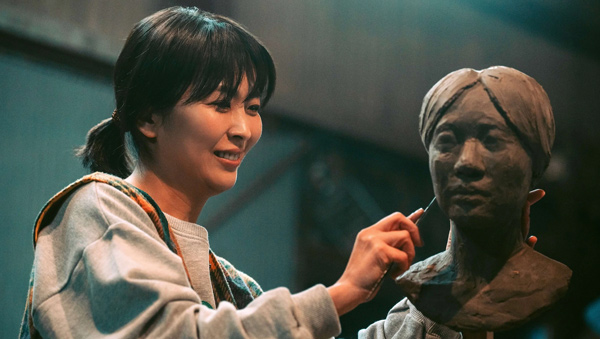
Certainly, Nagi Notes feels like Fukada at his gentlest, and there are passages which could easily be mistaken for something by Hirokazu Kore-eda. However, Fukada eventually slices through the ambiguities, evidenced quite charmingly through the budding romance between Keita and Haruki, which bears comparison to the strained friendship in Kore-eda’s Monster (2023). But a precise pattern begins to evolve, beginning with projections and assumptions with Keita recognizing Yuri from a composite of her likeness. In a quiet, slow, and methodical fashion the audience fills in the gaps the characters have been unable to bridge themselves. It’s clear Yuri and Yoriko have been dancing around how to define their relationship after Yuri divorced Yoriko’s absent older brother. Much like the sculpture of Yuri which begins to take her form, so does her own self-reflected identity become clear, the metaphorical building she’s constructed around herself opening doors to new possibilities.
The women’s past life choices suggest a myriad of regrets, and we learn Yoriko was actually in love with Haruki’s deceased mother, with whom requited feelings were shared. The impetuous decision of Haruki and Keita running away together to avoid an impending separation is the climax which showcases an opposite extreme, and Fukada’s refrain seems to be a study on how loneliness can overshadow us wherever we go because it’s one’s own choice to be defined by it. An unforeseen tempest simultaneously boils over concurrently with the repressed emotional turmoil long held at bay in Nagi, and suddenly, a sweet, simple clarity descends after the rain has gone.
Reviewed on May 13th at the 2026 Cannes Film Festival (79th edition) – Competition. 110 Mins.
★★★½/☆☆☆☆☆