

Magnificent Obsession: Di Marco & Picoli Patrol the Poison of Perfection
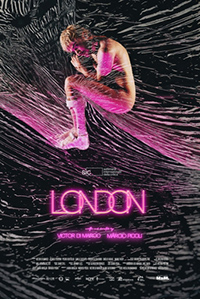 Our conditioned notions regarding beauty standards maintains our insidious and unhealthy fixation with obtaining (or maintaining) those attributes which remain most culturally celebrated. Despite ameliorative messaging wielded as a superficial nexus regarding individuality and loving one’s self, it’s often a paltry counter to the mental sabotage waged so prolifically it becomes a normalized part of our interiority. Such sentiments are barely more than a mantra designed as numbing lip service. In a world where GLP-1s have drastically changed a cultural shift in perceptions of body positivity, it seems the temptation is too great to turn down an opportunity to have the attributes once presumably out of reach—-and thus, presents scenarios whereby champions of self acceptance become disappointingly complicit in mutating to fit such standards. The real essence of body horror is the psychological thriller template we’re all navigating in our minds, and such is the sentiment of London, the directorial debut of filmmaking partners Victor Di Marco and Márcio Picoli, who have been sifting through similar themes across an array of short films.
London (Di Marco) is a young queer man with a disability working as a dominant in a fetish house in Porto Alegre, Brazil. His closest confidantes are his crippled friends and colleagues Luke (Pedro Bertoldi) and Lila (Jessica Teixeira), who provide him with the emotional support his estranged mother cannot. When new imaging technology offers London to receive a diagnosis for a neurological disorder he’s suffered from his entire life, he’s confronted with a potential crisis. Fearing the diagnosis will label him, and therefore hobble his identity, London struggles with evading the results, catalyzing his desire to disappear into the city he’s named after.

Maybe because of the explicit sexual environment defining London’s existence, the film can perhaps be easily traced to or compared with the clinical body horrors of David Cronenberg, where kinky death fetishes in Crash (1996) or perverse surgical procedures in Crimes of the Future (2022) produce new, hybrid human bodies, mangled beyond belief, pain overriding the pleasure component of the sexual experience. The opposite sentiment is at the heart of London, which suggests a proper diagnosis might allow for a more ‘normal’ future. But London has already carved out a fulfilling existence, his supposed disabilities making him unique from everyone else. An individual. There’s an essence of something like Flowers for Algernon (1959) at play here—-won’t London become less visible, less unique, after putting a name to his ailment? Will he unravel, be reduced by the label? His younger sister asks him early on why he’s named after a city. “Cities are places filled with people,” he responds, and London, like all people, contains multitudes. And is the diagnosis part of the cure or part of the (social) disease?

It’s quite evident the narrative is intensely personal to leading star and co-director Di Marco, and the film unspools like a gentle identity melodrama, leaving us (and London) at a bittersweet precipice. Societal expectations and attitudes are at the heart of what’s conflicting London as he’s stumbled upon the empowerment born from self-love and self-acceptance. As a gay man with a disability, his struggles sometimes parallel trans experiences in the necessity of rebuking social norms in the pursuit of self-actualization, refusals to be reduced for convenience or the comfort of others. There are few points of comparison for Di Marco, considering the lack of narrative centered on characters with disabilities, but London has the sexual levity of Ryan O’Connell’s comedic series Special and the recuperative essence of something like Jules Rosskam’s more experimental Desire Lines (2024). Di Marco and Picoli leave us with a strident clarity – the only time one needs to change is when they don’t yet love who they are.
Reviewed on September 6th at the 2026 Venice Film Festival (83rd edition) – International Critics’ Week. 90 Minutes.
★★★/☆☆☆☆☆