

Steal Big, Steal Little: Grozeva & Valchanov Deliver Just Deserts
 It’s difficult not to feel a sense of schadenfreude in following the drastic downfall of a long-married Bulgarian couple in Black Money for White Nights, the latest from directing duo Kristina Grozeva and Peter Valchanov, who broke out with a similar tale of ironic economic woe with 2014’s The Lesson. The maxim “karma has no menu, you get what you deserve” hangs like an albatross over a pair of elderly scammers who have siphoned funds from those in need to finance a lavish vacation in Moscow, where they plan to stay at a luxury hotel to experience the famed twenty-four-hour daylight when the sun never sets. Obviously, this celestial metaphor applies to the situation they’ve mastered for themselves, for the ‘white night’ phenomenon is also a state of constant twilight, mirroring the moral grey zone these characters have chosen to inhabit.
Marina (Tanya Shahova) and Gosha (Ivan Savoc) are a long married, childless couple who have painstakingly saved their money to go on a grand vacation in Moscow just prior to their inevitable retirements. She’s a nurse and he’s a train station master, but the pennies they’ve been pinching to fund their event are from the bribes they take from customers at their respective jobs. Just as they hand over the cold, hard cash to the travel agency hired to coordinate the trip, war breaks out in Ukraine. The travel agency suddenly disappears, bankrupted by the war, taking all of their money with them. First going to the police and then a seedy crime syndicate to recuperate their funds, it appears they’ve both been keeping disastrous secrets from one another and, quickly, their selfish world unravels.
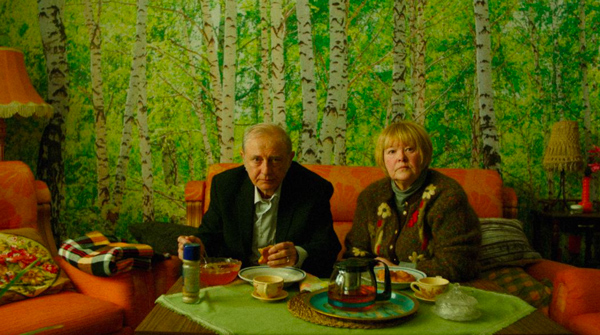
Marina and Gosha aren’t necessarily bad people, just inordinately selfish ones, and their scheme is wrapped up significantly in a sense of their identity as a couple. As everything becomes untethered, it’s clear they’ve also not been transparent with one another, and Grozeva and Valchanov have whipped up something which feels like an adult fairy tale or fable replete with a moral lesson about the necessity of living in the light. But transparency is not so fundamentally acquired overnight, as both of them come to learn. Marina thinks she’s being punished by God, desperate to repair the bad omen of a broken cross by buying another. A derelict priest on a swing-set (like something from a horror movie) tells her “When you lie, you pay in pain.” But interestingly, Marina’s search for calm through Christ highlights how religion is used as false atonement. Simply asking forgiveness is never enough.
As the news breaks about war in Ukraine, detailing canceled flights to Russia across the globe, the anguished Marina cries “What about us?,” as if she were a small child. In a broader sense, Grozeva and Valchanov are also making a bold statement about contemporary Bulgaria, where everyone across every profession seems prone to demanding kickbacks to satisfy even the basest of needs. But, this isn’t the case across the board, as evidenced by a nurse who sneaks Marina into the ICU to see Gosha. There is a way to hustle without hurting others. Likewise Marina’s dogged request to go to Russia instead of another country instead of somewhere less hostile to experience the white nights phenomenon. Through her younger half sister (an entertaining Margita Gosheva, the lead from The Lesson) it appears Marina believes her father, whose identity is unknown, is Russian. As the pieces fall together, it seems the childless Marina believes life has robbed her of normal necessities, and so she’s hardened her heart.
The film feels like a grand reunion of sorts for the directors, beyond Gosheva, once again working with Ivan Savov, who has appeared in all their previous projects. In their latest, he’s fashioned as something of a dupe who has made disastrous decisions of his own. Likewise Tanya Shahova, who has worked with them since 2016’s Glory, here playing the exact opposite kind of a character who was similarly scammed in Stephen Komandarev’s Blaga’s Lessons (2023).
A spiritual and physical reckoning occurs for both of them, leading to a sort of expiation, which curiously plays out as the end credits roll. It’s difficult to feel immediate empathy for this couple, and yet, Grozeva and Valchanov succeed in humanizing them as we delve into their secrets, the reasons for the choices they made. Everyone has their own story, and while this couple’s swing towards enlightenment was forced, it’s a wry but eventually emotional journey about the necessity of embracing decency.
Reviewed on July 7th at the 2026 Karlovy Vary Int. Film Festival (60th edition) – Crystal Globe Competition. 95 Mins.
★★★½/☆☆☆☆☆