

The Doctor and the Devils: Bechis Explores the Agony of Atonement
 The title for Argentinian director Marco Bechis’ latest title, Back to Buenos Aires, is apt in several ways. A return to his native country after fifty-five years, Bechis utilizes a fictionalized account about a prodigal native going back to testify about the tortures he endured in the late 1970s during Videla’s dictatorship. Bechis himself survived abduction during this regime, and once again, as he did with his 1999 title Garage Olimpo, returns to the infamous car repair shop retrofitted as a torture center during this period. It’s a quiet film reflecting on self-reconciliation and atonement, focusing as much on what’s not being said rather than delving into the gruesome details customary during explorations of those crushed by the brutality of these disastrous eras. Adriano Giannini (also in Paolo Strippoli’s The Spiral), son of Giancarlo Giannini, gives a quiet, internalized struggle of a man coming to grips with a past he’s been running from ever since.
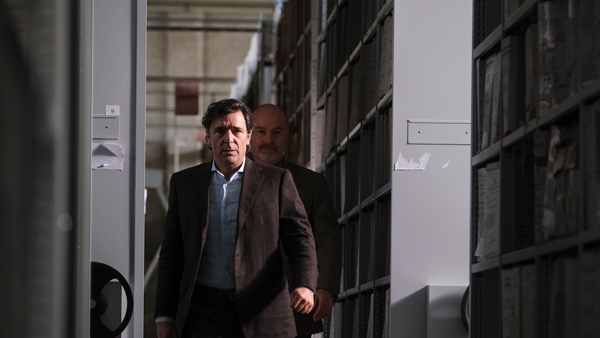
Mariano Guerra (Giannini) works as a paramedic in Torino. The year is 2008 and he has not been back to Argentina after escaping the dictatorship thirty-three years prior. But he has been called to testify in person at a trial where war criminals involved in torture at the Olimpo Garage, where Mariano had also been held, are finally being tried for their crimes. He’s initially reluctant to do so, but a flood of emotions and memories return when he’s confronted by fellow witnesses, some who believe Mariano’s hands aren’t so clean.
There are familiar mechanisms at work in Back to Buenos Aires which bear comparison to Ariel Dorfman’s play Death and the Maiden (adapted into a film by Roman Polanski in 1994), regarding a woman exacting revenge on the doctor who had tortured her during the Pinochet regime in Chile. Thematically, there are more parallels here than with Ricardo Darin’s Argentina, 1985 (2022), reenacting the first trial regarding war crimes under Argentina’s dictatorship. Part of this is how physicians who were brought in to revive victims undergoing torture ended up becoming assailants themselves, and had a higher chance of evading justice because their identities were kept secret (in Death and the Maiden, the only evidence the protagonist has is the memory of her rapist’s voice).
Come to find, Mariano may be the only person who can confirm the identity of Doctor K (a very Kafkaesque nom de guerre), and it’s this abusive relationship which provides Back to Buenos Aires with its most difficult moments. Part of Mariano’s reluctance relates to the guilt he feels for information he revealed while being tortured implicating others who did not survive. He’s told before his scheduled testimony he could walk away from the experience being a defendant because it seems Doctor K made Mariano his assistant, and he became sort of like a ‘kapo’ in relation to the other prisoners. Also, it’s suspicious how and why Mariano actually survived. Much like Bechis himself, Mariano’s Italian passport may have also played a role in saving him from the same fate of his comrades.
Where Back to Buenos Aires feels a bit slim is with providing any other real dimension for Mariano, working as a paramedic in Torino, clearly estranged from his daughter. Likewise two other women who intersect with Mariano prior to the trial feel a bit conveniently placed. There’s another witness returning to testify for the fourth time as she’s ready to reveal the extreme sexual assault which also occurred, and then an orphaned daughter of a woman who had been close to Mariano. In the finale, a strange dance party, which plays like a commercial for prescription medication, allows for a metaphorical window into Mariano’s mind. Other similar visual cliches include his reflection in a shattered mirror, but the audience has to make a lot of presumptions about just how compartmentalized Mariano’s identities actually are. Ultimately, it’s a rather sedate approximation of survivor’s guilt despite brief details revealing some of the horror that was endured.
Reviewed on September 11th at the 2026 Venice Film Festival (83rd edition) – In Competition. 105 Minutes.
★★½/☆☆☆☆☆