

The Children’s Hour: Kreutzer Poses Provocative Dilemmas
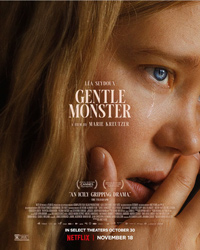 The complex trappings of denial are at the heart of Gentle Monster, the latest from Austrian director Marie Kreutzer, a narrative juxtaposing scenarios wherein two women are forced to confront potential complicity in how their expected kinship roles might play a part in permitting patterns of assault instigated by men in their lives. It’s a return to the blurred boundaries and indiscretions examined in Kreutzer’s corporate ethical dilemma drama The Ground Beneath My Feet (2019), where unprocessed familial dysfunction germinates toxic whirlwinds in the mind numbing sterility of a woman’s work life. In other words, Kreutzer once again employs a blunt, sobering portrait of compromised relationships utilizing provocative window-dressing, this time with a backdrop of pedophilia and sexual assault going on right under the noses of women whose own professional endeavors inform their responses.
Pianist Lucy Weiss (Seydoux) has recently moved to the German countryside with her husband Philip (Laurence Rupp) as a way to reset following his own creative burnout as a financially unsuccessful documentarian. Before they’re settled into a new routine, a horde of police officers descend on their home with a search warrant, led by a stern but kind detective, Elsa Kuhn (Jella Haase). It appears Philip is being investigated for the distribution of child pornography, and all his electronic devices are seized. Lucy is thrown into immediate turmoil, absconding with her son John to her mother’s (Catherine Deneuve) apartment. Weeks go by as Lucy waits for some inkling of her husband’s innocence before she reveals to any friends or family members what’s going on. Defenses are planned, excuses are made, but each new revelation creates more questions.
Seydoux has, at this point in her career, proved her innate ability to channel distress with an emotional range making almost any scenario she’s placed in utterly convincing. And as Lucy Weiss, she does not disappoint. One of the rare narrative details offering intriguing relief from the uncomfortable misery of the narrative is watching Seydoux as a world renowned pianist who is known for performative deconstruction of pop songs written by men. A brief interview after a sold out concert in Berlin informs us her aim is to engage with cultural constructs written by men which serve as filters for their emotions they are not otherwise allowed to express (it’s a pity we couldn’t get Seydoux working her way through Bob Seger), questioning if these mainstream constructs aren’t simultaneously operating as honey traps or elaborate lies. It’s the most intriguing and complex element of Kreutzer’s film, suggesting Lucy has honed her own siren songs using the devices of men against them, funneled through the instrument of her own self. Her other contextual elements, such as being forced to move to the countryside due to Philip’s emotional issues, aren’t really properly addressed (despite a running time which should have allowed for it), but there’s the suggestion of a Die My Love (2025) thread of cannibalized personalities magnified by alienation and sacrifice.
In a rather rudimentary way, Gentle Monster leads us through Lucy’s rage and denial as she processes Philip’s excuses, consistently forced to reckon with the possibility Philip is lying and actually guilty of the crimes he’s been accused of. The iconic Catherine Denueve is her detached mother who doesn’t have much to do, the ‘sagest’ advice to her daughter suggesting vomiting as a metaphorical way to cleanse her spirit of the love she’s felt for an evil man. Kreutzer follows up with the obvious by seeing Lucy do just that.
As compelling as Lucy’s grappling is with a nightmare scenario, where Kreutzer really gets bogged down is through the parallel examination of Jella Haase’s Elsa, an investigator who pities Lucy but has a comparable issue in her how backyard with her father, a man suffering from dementia who has been sexually inappropriate with his live-in nurse. The slippery slope isn’t so much her father’s actions but Elsa’s own role in trying to convince the nurse to stay in an abusive environment, a traitor to her gender and professional training. Haase’s buttoned up performance serves as a counter to the emotional Lucy, her characterizations also consisting of polar opposite details such as how she listens to pulsating hip-hop music in her car. Elsa is consuming the toxicity of the patriarchy and unwittingly complicit despite an occupation which provides her the power to do the opposite. Meanwhile, Lucy is creatively dismantling the hierarchy, offering new possibilities.
Ultimately, however, Gentle Monster is perhaps a bit two striated in its examination of these two women and their eventual choices. While Seydoux approaches her role with customary fervor, Kreutzer isn’t able to convey the same sense of connection so magnificently accomplished with her portrait of Empress Elizabeth in Corsage (2022) portrayed by Vicky Krieps. The end result is a hollow triumph and perhaps Kreutzer needed to be more daring to meet the material where it’s at, whether that be with shades of exploitation such as The Naked Kiss (1964) or with the complex combination of vitriol and empathy in Little Children (2005). Perhaps, it’s just ultimately avoiding the contradiction implied in the title, neither gentle nor monstrousness and disappointingly a bit routine.
Reviewed on May 15th at the 2026 Cannes Film Festival (79th edition) – Competition. 114 Mins.
★★/☆☆☆☆☆