

(Get) Away From Her: Hammer Returns with Elder Ethical Dilemma
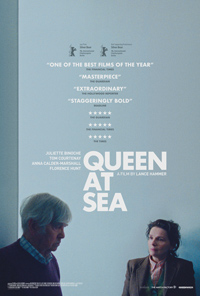 It’s been nearly twenty years since Lance Hammer’s 2008 debut Ballast announced a major new talent in American indie cinema and his sophomore effort has been highly anticipated ever since. He steps outside of the US for the unveiling of his sophomore feature Queen at Sea, headlined by iconic Euro actors Juliette Binoche and Tom Courtenay. Hammer remains fascinated with the ripple effects between lives connected to a specific event, and the heart of the matter here is a provocative one. A daughter, concerned with her mother’s ability to consent to sex reports her step-father’s activities to the police, dramatically shifting the already tenuous arrangements in place. Spliced with intergenerational conflicts within this specific familial unit, Hammer explores the importance of context and boundaries even within the most private of institutions.
Amanda (Binoche), a professor, has temporarily moved to London from Newcastle while taking sabbatical so she can be closer to her mother Leslie (Anna Calder-Marshall), who is suffering from the advanced stages of dementia. Upon visiting her mother with teenage daughter Sara (Florence Hunt) in tow, Amanda discovers her step-father Martin (Tom Courtenay) having sex with Leslie. And it seems Leslie doesn’t know what’s going on. Berating Martin, who had apparently promised to stop this behavior, Amanda calls the police, setting off a chain of events forcing them to contend with a grim reality they thought might still be somewhere in the future.

Not surprisingly, Binoche is a formidable emotional anchor in an already overwhelming scenario. A divorced single mother whose own future remains unclear, she’s committed to doing right by her mother, but the situation is much more complex than she perhaps anticipated. Martin is an absolute necessity in providing the best possible loving care and comfort for her mother, but it’s increasingly clear there are not only conflicts of interest (so to speak) but a worsening condition requiring her mother be placed in an assisted care facility.
There are echoes of Gaspar Noe’s Vortex (2021) as well as Michael Haneke’s Amour (2012), but Hammer’s position isn’t nearly so dire as either of those narratives. Courtenay is understandably in denial about his decisions to remain sexual with his wife, though circumstances slowly reveal his comprehension shifts. Anna Calder-Marshall (who played Cathy to Timothy Dalton’s Heathcliffe in Robert Fuest’s 1970 version of Wuthering Heights) is distressing to behold as Leslie, and in many ways, Hammer excels at portraying the sexual dimensions in these scenarios so often glossed over.

The opening set-up of Queen at Sea provides the film with its most powerful moments. Coitus is interrupted, the police are dispatched, a rape exam is required. How Leslie reacts to the medical exam causes further emotional trauma for both mother and daughter, and it’s a strenuous moment to witness. The eventual bureaucratic involvement initially seems to complicate matters, but clearly something about the care arrangement for Leslie needs to change. Binoche’s Amanda is resilient in her efforts to do the right thing, but is quick to quesion if she’s also perhaps overstepping her bounds. What arrangement serve Leslie’s best interests, especially when she cannot articulate her thoughts or needs?
While it lends us a necessary reprieve from the agonizing realities of Leslie, Hammer’s frequent asides with teenage daughter Sara, who is exploring her own sexual awakening with a boy from school, tends to slow down the pacing. Sure, this gives us a little interiority for another character with limited agency, but there’s nothing innately intriguing about these adolescent meanderings other than also providing a context which suggests Sara is being granted the space to define her needs just at the point where her grandmother’s has been completely eradicated. Yet the most interesting perspective here is that of Amanda, at the mid-life point where she can see what the loss of her own autonomy might resemble just as her daughter seizes her own. It’s a film that’s not so much heartbreaking as it is a grim portrait of realistic human experiences. All of these characters are a bit lost at sea, and if anyone’s steering the ship, it’s Amanda. For now.
Reviewed on February 17th at the 2026 Berlin International Film Festival (76th edition) – Main Competition. 121 mins.
★★★½/☆☆☆☆☆