
The Sun Also Rises: Boyle Explores the Origins of Media Sensationalism
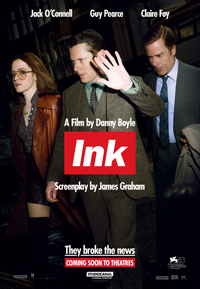
If, as Alan Moore posits, “It is the job of the artists to give the audience what they need,” how, then, is it not the responsibility of the journalist to do the same? Danny Boyle adapts James Graham’s 2017 stage play Ink for his latest feature, tapping into the same contemporary examination he attempted in Jobs (2015) to contemplate how powerful figures utilized their platforms to irrevocably change a cultural landscape. The play and film trace us back to 1969, during the early days of oligarch Rupert Murdoch, when he purchased the dwindling Fleet Street rag The Sun and transformed it into a tabloid sensation upon partnering with ambitious editor Larry Lamb, a collaboration which would provide an influential template for the evolution of journalism from objective reporting to a destructive conduit for an increasingly divisive, twenty-four-news cycle.
In what sounds like a contemporization of mythological proportions, Australian born American business magnate Rupert Murdoch (Guy Pearce) purchased the tabloid newspaper The Sun from the International Publishing Corporation in October, 1969, at last securing his highly desired footing on Fleet Street. In what was supposedly doomed to be a dying star, Murdoch cribs ex-sub-editor of the Daily Mirror, Larry Lamb (Jack O’Connell), who has a significant axe to grind with his former boss, Hugh Cudlipp (Bertie Carvel). Purloining a large number of The Daily Mirror’s staff, including his lover Jules Davies (Claire Foy), a fictional composite of several women, his time of free spirited misfits retool formulas to appeal to the working class. With the odds stacked against them, Lamb’s team manages to tap into the base elements of the zeitgeist’s id during highly volatile cultural climate changes. But eventually, it seems nothing is too sacred for print, with The Sun setting precedents which would irrevocably change the face of media, and an art form once known as journalism.
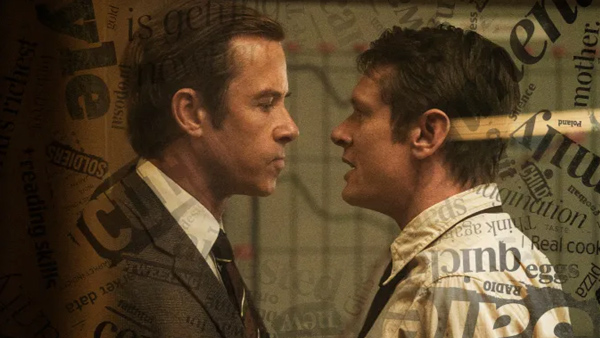
Success may indeed be the best revenge, and perhaps the most interesting element of this saga is how significant cultural gatekeeping by the old guard led to the breaking of all boundaries and norms, consequences be damned, all for the sake of selling the most papers. It’s a tale of Machiavellian excess, and while Boyle doesn’t lay all our modern ills at the feet of Murdoch and Lamb, it is, boiled down (pun intended) in the classical sense, to yet another tale of brash hubris. Ultimately, this is another moral fable exemplifying “For what shall it profit a man if he should win the whole world, yet he loses his own soul?” As far as Rupert Murdoch, it profited him a whole lot.
Boyle’s overly stylized take tries to make this a sexier ‘battle over the integrity of journalism’ a lot pulpier than it deserves to be. And at the same time, he plays it safe. Jack O’Connell and Claire Foy succeed at channeling this glossiness without generating contempt, and they imbue the film with a jaunty energy reminiscent of an underrated Ron Howard flick, The Paper (1994)—-though there’s nothing quite like watching Glenn Close and Michael Keaton engage in an extended bout of fisticuffs beneath the presses here. On the other hand, Guy Pearce, who seems to have been directed to go even bigger and broader with the spineless elitist angle than in The Brutalist (2024) ends up being pure caricature—-even Malcom McDowell’s stint as Murdoch in Bombshell (2019) has more dimension. Here, Pearce pants and snarls, all bark and no bite, conveniently assuaged by the clockwork phone calls confirming even greater paper sales every time he finds himself in doubt about Lamb’s sleazy methods.
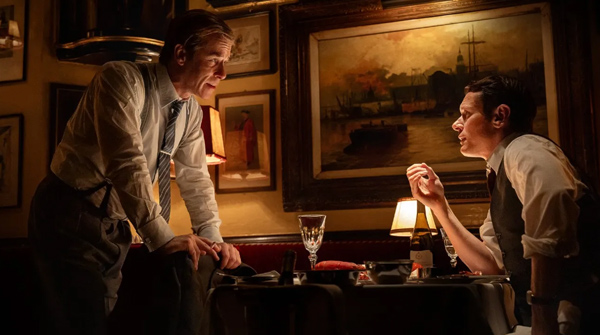
Murdoch and Lamb, however, are hardly geniuses. They simply recognized an opportunity to utilize shock value methods in ways previously not allowed (or, rather, dared). The kidnapping and murder of Press Chief Alick McKay’s (Jonathan Hyde) wife Muriel (Lucy Russell), and the interference of the press while the investigation was unfolding, serves as a case study deserving its own film. Here she’s merely a footnote, just as she was a means to an end for Mr. Lamb. Later, as Lamb points out during the staging of his greatest coup (printing a photograph of a topless, nubile woman in a ‘family’ paper) to a trepidatious model, “If not you, it will be someone else.” And that’s exactly what Murdoch and Lamb are, trailblazers of a transgression someone else would have eventually made. Hardly the vicious castigation on media corruption as something much earlier, Billy Wilder’s masterful Ace in the Hole (1951), Ink may feel like it charges in like a lion, but it definitely goes out like a lamb. Lily Allen’s track “The Fear” capitalizes on the same subjects with greater satirical finesse – “I’ll look at The Sun and I’ll look in The Mirror/I’m on the right track, yeah, I’m on to a winner.”
Reviewed on September 2nd at the 2026 Venice Film Festival (83rd edition) – In Competition (Opening Film). 106 Minutes.
★★½/☆☆☆☆☆