

Rosé is the Warmest Color: Herry Explores a Liver of No Return
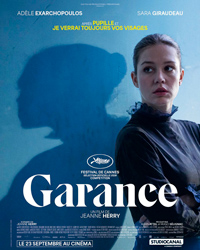 In several ways, Jeanne Herry’s latest socially conscious drama Garance (unfortunately outfitted with the inconspicuously bland international title, Another Day) serves as a maturation of her storytelling style, inexplicably forced to cut through the chaotic ensemble nature of her favored structure to finally settle into the promise of the actual in-depth character study of her titular character. Herry, daughter of revered French star Miou-Miou (notably absent from this production), reunites with Adéle Exarchopoulos, who won a Best Supporting Cesar Award for her turn as an incest/sex abuse victim in All Your Faces (2023). Subtle, at least by comparison, their latest venture concerns a young woman, desiring to succeed as an actor but hobbled by her inexplicable addiction to alcohol.
Garance (Exarchopoulos) is a young Parisian woman who finds joy in her employment as an actor with a local theater troupe. An unwanted pregnancy awakens her to the dead-end possibilities of a current relationship, forcing a move to the suburbs. But Garance is a high-functioning alcoholic, and as she begins to spend more time on her own, she begins to spiral out of control. Eventually, her living situation and livelihood are threatened by her behavior, until she meets the gentle Pauline (Sara Girardeau), and romance finally allows Garance to see a future beyond all tomorrow’s parties.
Cinema is littered with phenomenal performances by actors conveying the devastating effects of addiction and alcoholism. To her credit, Herry tries (in sometimes ineffectual ways), to avoid the standardized cliches. There are moments of morbid humor (such as Garance explaining to her physician how healthy she feels after six months of sobriety whilst she gently chain smokes her way to a new horizon). But never does the film ever approach the magnificence of perhaps the most subversive portrait of a woman under the influence, Tabea Blumenschein of Ulrike Ottinger’s Ticket of No Return (1979). Instead, Herry heads to a lesbian version of Leaving Las Vegas (1995) thanks to the charming and disarming relationship developing between Garance and Sara Girardeau’s soft-spoken, perilously sympathetic Pauline (both actors are also well-matched in their significantly juxtaposed speech patterns, adding a depth to some relationship building that could have felt excessively twee or cutesy).
Strangely, there’s never a real sense of Garance hitting rock bottom. What Herry better establishes is how difficult it is to play witness to friends or loved ones as they spiral. There are matters of narrative convenience which seem to give Garance an easy out, such as her cancer-ridden sister, played with a proper level of grace by Mathilde Roehrich. Likewise her disastrous diagnosis of severely depleted liver function, which finally backs Garance onto a ‘shit or get off the pot’ precipice.
Much like the previous All Your Faces (2023) and the earlier In Safe Hands (2018), Herry tends to lean into contemporary mainstream semantics comparable to several of her modern peers, such as Emmanuelle Bercot or Maiwenn, all who favor exaggerated, overblown dramatic scenarios populated with a dizzying amount of supporting characters, often resulting in what feels like a lot of impenetrable noise. Garance begins on this uneasy footing, a conversation between the sisters serving as a moderating or offbeat narrative guide leading through a sobriety journey. A stark reminder of how the filmmaking could better assist rather than work against the vibrant lead performance from Exarchopoulos is Herry’s choice to showcase the women watching Pauline’s favorite film, the Marcel Carne masterpiece Children of Paradise (1945), which features the iconic Arletty as a woman nicknamed, Garance, of course.
Repetitive sequences and crunchy dialogue (Garance having to describe to her soon-to-be ex-employer a mastectomy as her sister inheriting ‘industrial boobs,’ for instance) bog down the immediacy of the character’s plight, which ineffectually leans into the pandemic era as way to extend her conquest with white wine. Strangely, Herry doesn’t lean into the red colored flower from which Garance’s name is derived, a motif which could have been plundered effectively as a visualization for her plight (something Stephen King utilized in his 1995 novel Rose Madder, the red paint made from the dye of this flower). But then, Herry seems hardly interested in actually exploring the hellish and halcyon days of wine and roses.
Reviewed on May 17th at the 2026 Cannes Film Festival (79th edition) – Competition. 120 Mins.
★★½/☆☆☆☆☆