

Only Mothers Left Alive: Bergholm Tackles Motherhood Malaise
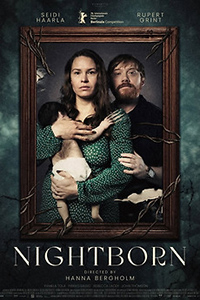 Finnish director Hanna Bergholm adds to the subgenre of motherhood body horror with Nightborn (Yön Lapsi), an arguably more contained palette than her 2022 debut Hatching, which similarly dealt with female body image expectations and dysfunctional kinship roles. Her latest feels more like situational comedy, whereby a woman’s ‘madness’ is triggered by a couple’s move to an isolated, dilapidated family home in the eerie thickness of a fairy style primed Finnish forest. Settling into a familiar groove, it’s a film wherein the idiosyncratic wavelength’s success depends solely on the increasingly untethered lead performance from Seidi Haarla, who certainly throws herself admirably into full tilt weird.
Sarga (Haarla) and her British husband Jon (Rupert Grint) arrive at the run down home once occupied by her grandmother in the Finnish countryside. The facade needs considerable renovations, but the happy couple is determined to leave behind city life and follow their fantasy of rearing three children in isolated rural bliss. They begin work on this immediately, and Sarga becomes pregnant. It’s an early birth, so much so the couple can’t even finish fixing up the house. Immediately, it appears something is wrong with the child, according to Sarga. The child is loud, rough, and hairy, aggressively drawing blood from her nipples while breastfeeding. Increasingly, it appears she might be losing her mind, believing the child belongs to the race of creatures her grandmother feared in the deep, dark woods. She begins feeding the child cow’s blood, which alleviates some of her stress, and, eventually, it seems her inclinations might be true. And still, no one will believe poor Sarga.
While it wasn’t particularly well-received, Marielle Heller’s Night Bitch (2024) looms large as a comparison, both in title and theme. Heller’s adaptation depended upon metaphorical flourishes to embody a mother’s changing relationship with her body (among many other things) after childbirth, and there’s something which becomes a bit rote in the confirmatory supernatural elements which define the dramatic climax in Bergholm’s exercise. Arguably, the resolution here, if indeed there is one, is much darker in its fatal implications, but Bergholm dances around suggestions that infant Sarga was afflicted by the same ‘conditions.’ Besides a fornication sequence on the mossy forest floor, it’s not clear why exactly Sarga’s child is a vampiric troll creature, though this saves obvious comparisons to something like Rosemary’s Baby (1968) or another Berlinale competition title, Mother’s Baby (2025). The set-up actually feels strikingly similar to Lynne Ramsay’s Die My Love (2025), in which postpartum depression issues wreak havoc on a young mother who also, perhaps unwisely, agreed to isolate herself in the woods.
Bergholm seems to be fascinated with young women reared by either monstrous or detached mothers, and most of the comedy arrives in the form of Pirkko Saisio as Sarga’s disinterested parent. Much like in Hatching (read review), she’s a mom who seems to feel somewhat contemptuous toward her children, though in turn, they seem to have unexplored rivalries regarding her attention. If there’s a particularly obvious problem with Nightborn, it’s how these relationships are superficially rendered, leaving Sarga as a free floating tornado swirling around ragged bits of debris who sometimes clank around in the eye of her storm. This includes the curious presence of Harry Potter alum Rupert Grint as a well-meaning, perilously milquetoast husband, who, like many male characters before him cut from the same cloth, is flagrantly oblivious.
Set design and cinematography from Pietari Peltola effectively set the scene, and the real genre joys of Nightborn arrives in the infrequent sojourns to a forest filled with creepy tree-human forms (though these could have been even more sexual and grotesque, a la John Waters’ A Dirty Shame, 2003). However, a blood spurting birthing scene does hit the bullseye. Otherwise, our level of discomfort exists in the sonic realm with the throaty squalling of the hirsute goblin child. One’s familiarity with similar agonized portraits of motherhood may dictate how novel Nightborn might seem, though it’s lonely, traumatized Sara who makes one want to stay until the end credits.
Reviewed on February 14th at the 2026 Berlin International Film Festival (76th edition) – Main Competition. 92 mins.
★★½/☆☆☆☆☆



 Movie Review: Visit IONCINEMA.com for more World Cinema news, reviews & interviews!)