

How Awful About Allen: Tsukamoto Continues Charting Casualties of War
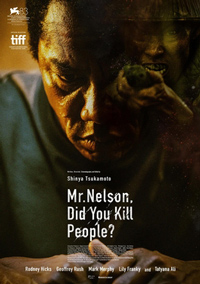 “Ain’t war hell?,” asks the door gunner to Matthew Modine’s protagonist in Stanley Kubrick’s Full Metal Jacket (1987), arguably one of a handful of iconic American films depicting the horrors of the Vietnam War. It’s meant as a rhetorical question following a shocking admission regarding the targeting of innocent women and children, and the most successful cinematic ventures attempting to reenact the brutality of war at least allow us to gaze into this abyss, which, if we are to take anything away from consuming such narratives, should be allowed to gaze back into us. Although he’s best known as an originator of cyberpunk body horror cinema with his cult favorite Tetsuo: The Iron Man (1989) and its ensuing sequels, Shinya Tsukamoto has spent the last decade making punishing war narratives. Curiously, he continues this trend with his English language debut Mr. Nelson, Did You Kill People?, which relays the experiences of Vietnam veteran Allen Nelson, a Black American who spent decades of his life dealing with PTSD before eventually processing his trauma and sharing his story through thousands of speaking engagements before his untimely death at the age of sixty-one due to multiple myeloma, acquired through exposure to Agent Orange.
We are introduced to Allen Nelson (Mark Merphy) shortly after he’s been discharged from service in Vietnam, living on the streets of Philadelphia and suffering from PTSD, though this was not terminology used at the time. A friend from school, who is now a teacher, stumbles into Allen, asking him to speak to her class of elementary students to share his experiences. This seemingly instigates a process towards his recovery. Several decades later, Allen (Rodney Hicks), married to Linda (Tatyana Ali), is seeing a therapist, Dr. Daniels (Geoffrey Rush). He shares the traumatic details of his experiences during combat, finally leading to a breakthrough connecting his actions with traumas from his past.
Although a high percentage of Black men were on the front lines during Vietnam, until recently, there have been few films which actually place their perspectives front and center. Sure, there are high profile supporting turns in most of the major American auteur features depicting the Vietnam War, such as a young Laurence Fishburne and Albert Hall in Apocalypse Now (1979). A stellar ensemble features Keith David, Forest Whitaker, Reggie Johnson, Corey Glover, Corkey Ford, and Tony Todd in Platoon (1986). Ving Rhames, Erik King, and Wendell Pierce all get screen time in Casualties of War (1989), likewise Dorian Harewood and Gary Landon Mills in Full Metal Jacket (1987). Juney Smith and Forest Whitaker (again) in Good Morning, Vietnam (1987), and let’s not forget the agonizing Adrian Lyne genre film Jacob’s Ladder (1990), featuring Eriq La Salle and Ving Rhames (again). So among the essential narrative masterpieces documenting soldier’s experiences during the Vietnam War, there are no leading Black roles. Now, there was a 1995 film directed by Preston A Whitmore II you’ve likely not heard of called The Walking Dead, starring Allen Payne, Eddie Griffin, and Joe Morton. Spike Lee slid in with 2020’s Da 5 Bloods, featuring an underrated performance from Delroy Lindo and the late Chadwick Boseman. And on the documentary side, two 2026 films, Soul Patrol and Brothers in Blood: Black in Vietnam had film festival premieres, and are, as of yet, awaiting theatrical release. In short, Mr. Nelson is only the second narrative feature to focus on a Black Vietnam vet as a lead protagonist, with the last being from over thirty years ago.
To his credit, Tsukamoto has elevated his latest beyond the galvazning torture porn of his last few efforts, which often succeed in shocking his audience into desensitization. His 2014 remake of Kon Ichikawa’s 1959 classic Fires on the Plain, detailing a Japanese soldier’s experiences in the Philippines during WWII, does a disservice to the original while 2018’s Killing is weighed down by its Edo period setting (though the tagline for that film, “Why Must I Kill?” is pertinent in this latest venture as well).
There’s a much more evident human touch with Tsukamoto’s latest film, although the narrative is arguably grinding the hell out of its gears to include it, which sometimes lends a sense of maudlin histrionics. But it’s the processing of Allen Nelson’s grief which actually elevates this beyond exploitative brutality. This is thanks almost exclusively to a highly emotive performance from Rodney Hicks, one of the original cast members from Broadway’s Rent. He is mirrored in intensity by newcomer Mark Merphy playing the younger version of Allen, and it’s a duality which eventually feels immersive, narrated as it is by his adult self to his therapist (a rather placid Geoffrey Rush, who seems to be lending his his name more than his presence to the proceedings). There’s a delightful novelty in getting to see Tatyana Ali as Allen’s empathetic wife, and though she has little to do beyond providing quietly serious support, she’s a welcome, legitimizing asset. The same can also be said of a brief turn from Koreeda regular Lily Franky as a helpful conduit for Allen to return to Vietnam for a final tier of expiation.
At times, the production doesn’t live up to the intensity of its leads, but Hicks gives a performance which rivals the turn Tsukamoto generates from pop singer Cocco in another career highlight, Kotoko (2011). Likewise some important details are glossed over, such as how exactly Allen went from being homeless to marrying Linda, so it’s not as if audiences might not be left with a nagging sense of major questions being left unanswered. As a distinction from his previous filmography, Tsukamoto at least depicts a way out of being defined by trauma through a strident sense of honor and a necessary element of recuperation.
Reviewed on September 4th at the 2026 Venice Film Festival (83rd edition) – In Competition. 116 Minutes
★★★/☆☆☆☆☆