

Even Cowgirls Gets the Clues: Sirot/Balboni Rewrite the Past…in the Future
Belgium tandem Ann Sirot and Raphaël Balboni take the machinery of the western — revenge, the masculine menace, tombstones and a heroine carrying a grievance — and turn it inwards with Un détour par Diane. Of course, this is more a text about how violence thrives and survives long after the original wound – its generational and distinctly female. With the stop-start, jump-cut comic rhythm also found in The (Ex)perience of Love, (read review), the film’s lead Ninon Borséi has the zest and zeal to make Diane’s uphill battle watchable, but while her quest for some form of justice gives the film its drive, the scattershot energy can sometimes work against its emotional impact.
She hates men as much as she desires them. In a creative sequence of hooking up intimacy, the thinly framed Diane expresses her sexuality with a fluid, don’t give a F state of mind, but there something sort of inner discord that comes about — the kind where we could imagine that her rapport with the opposite gender has been somewhat influenced in her upbringing. When her mother (Sandrine Blancke) reveals a traumatic event from her past, Diane rearranges the emotional geography of her life. What she experiences as revelation, her mother experiences as something closer to an intrusion: Diane wants justice, while her mother wants the freedom to finally become the woman she might have been. Here the screenplay doubles up on the charted expeditions to self.
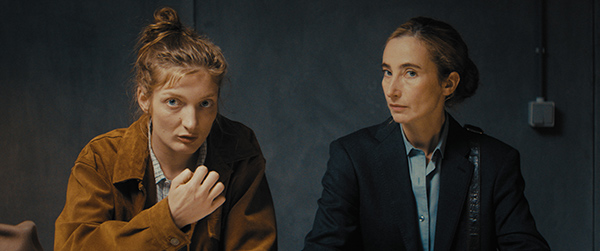
With this young woman trying to understand why desire, anger and her relationship to men have become so entangled, the story throws in a subplot where her lover, Lucas Meister’s seemingly ideal boyfriend-material suitor, may also be a potential enemy — this time through an inheritance twist. It feels unnecessarily over-the-top, but very much in the Sirot/Balboni wheelhouse, where murky matters are deliberately kept airy and the absurd is allowed to sit alongside the serious.

The film’s most compelling idea how the mother’s silence becomes its own kind of inheritance, while Diane’s determination to avenge her threatens to reopen the very wound her mother has spent a lifetime trying to close is a bit too all in as a narrative distraction. Borséi’s combustible physicality and antics come across as a faux revenge — it takes a lot to buy into how this pain is shared, manifested and expanded. Un détour par Diane asks whether confronting inherited violence can actually liberate us — but the overall tone feels a bit trapped itself.
Reviewed on September 5th at the 2026 Venice Film Festival (83rd edition) – Orizzonti. 92 Minutes.
★★/☆☆☆☆☆