

It is Seldom That a Dream Comes True: Sachs Sends Regard with Poignant Elegy
In the realm of contemporary queer auteurs, there isn’t anyone quite like Ira Sachs and his collaborating writer/partner Mauricio Zacharias who utilize cinema as a medium of arthouse recuperation. For the past twenty years, Sachs has delivered a wide ranging display of queer experiences and interactions, often informed by direct deliberations with obscure inspirations that might otherwise be left dormant or undiscovered, such as 2025’s Peter Hujar’s Day. Working in a similar vein of intergenerational splicing is their latest marvel, The Man I Love, a title relating to the track written by Ira Gershwin, one of two stirring songs performed by lead Rami Malek, who has the novel opportunity to tackle a role which allows him to explore and flesh out all the tics and travesties of a larger than life persona cut short by AIDS.
Theater actor Jimmy George (Malek) begins rehearsals as the lead role in what will likely be his last production. Only recently has he recovered from a stint in the hospital due to AIDS related complications. His partner Dennis (Tom Sturridge) wearily continues to care for Jimmy, though he’s relegated to the sidelines when a handsome new tenant in their building, Vincent (Luther Ford) begins amourous pursuit. As rehearsals commence, it appears Jimmy is on edge, having difficulty learning his lines. Meanwhile, his loving sister Brenda (Rebecca Hall) and her husband Gene (Ebon Moss-Bachrach) try their best to support him from a distance.
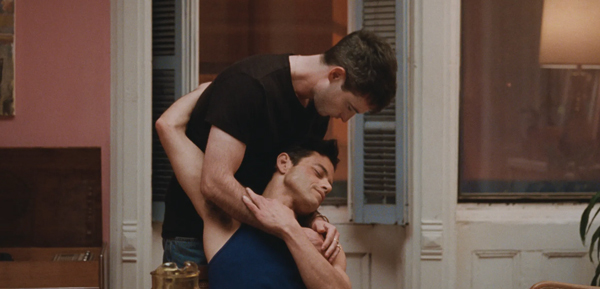
Sachs has never shied away from messy relationship scenarios, and The Man I Love exists as a pattern and conversation piece with Turn the Lights On (2012), Love is Strange (2014) and Passages (2023). Despite displaying a reverence for queer personas and artifacts, this is the first time Sachs has directly recuperated elements of the AIDS crisis, and it serves like an homage for the countless gay men who lost their lives during their prime. The creative mechanism of layered recuperation is an obscure queer French-Canadian film from 1974, directed by Andre Bressard, adapted from several plays by Michael Tremblay, Once Upon a Time in the East. The theatrical production is, in essence, doing what Sachs aims to do, recuperating queer texts forgotten over subsumed by time. The film is littered with visuals and snippets of similar elements passed down or between generations of gay men, such as Vincent introducing Jimmy to Rita Pavone.
The surprising element here is Rami Malek, a performer who often tends to overwhelm the environments he inhabits, flaunting his approaches and methods which usually draws attention to all the wrong places. For once, Jimmy seems a perfect fit as a larger than life creative force contending with his sunset, his faculties disappearing right before everyone’s eyes. It’s not so much that Jimmy’s relationship with Dennis is messy, but rather, tenderly realistic. Luther Ford’s naive, obnoxious ingenue blusters into their lives like a bull in a china shop, never realizing the purpose he serves is as a farewell to Jimmy’s romantic and sexual prowess.
Malek is given the opportunity to sing two complete numbers, the titular Gershwin tune, and, more arrestingly, an emotional rendition of Melanie Safka’s “Look What They Done to My Song, Ma” during his parents’ fiftieth anniversary party (an event his partner was not invited to attend). Malek is supported by an impressive supporting cast, but it’s Tom Sturridge and Rebecca Hall (who was also exceptional in Peter Hujar’s Day) battling their acceptance of Jimmy’s inevitable exit. It is Sachs’ most galvanizing characterization since Dina Korzun in Forty Shades of Blue (2005).
Music provides many of the emotional cues, such as when the score, reflecting Vincent’s despair at being abandoned by Jimmy, overwhelms the music of his choosing for escape, reminiscent of the discordant way Godard would often utilize and then deny the catharsis of song. A bonding session at a party allows each reveler to share a musical number which means something to them, unstated bonds and experiences hanging over the ensemble like ghosts. The expected climax leads to opening night, a last chance at reclamation dashed aggressively, an upset which resembles the zenith of a failed Fassbinder heroine (Margit Carstensen in The Bitter Tears of Petra Von Kant, or Rosel Zech in Veronika Voss). Beautifully photographed by DP Josée Deshaies (wife of Bertrand Bonello, who lensed his 2023 masterpiece The Beast), the essence of 1980s New York is conveyed through the sacred spaces of the cramped theater and the electric energy of gay night clubs and lounges, where communities gather for sustenance, both mental and physical.
“It’s a tough business, living,” remarks Jimmy’s brother-in-law. But catharsis is the burden of the survivor, the dance floor an engine for healing as Ronee Blakley’s “Lightning Over Water” plays through the end credits. The track was used in Wim Wenders’ documentary on Nicholas Ray, which also premiered at the Cannes Film Festival in 1980, overlapping cultural artifacts at the same finish line. Our echoes exist in this ether, waiting for future frequencies to project and reflect.
Reviewed on May 20th at the 2026 Cannes Film Festival (79th edition) – Competition. 95 Mins
★★★★/☆☆☆☆☆