

They Shoot Agents, Don’t They?: McDonagh Morosely Reflects a Pernicious Empire
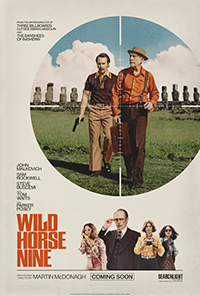 Americans can’t quite seem to directly engage with their ills of the present by connecting them with misdeeds of the past, for a myriad of reasons, but this translates in a lack of contemporary cinematic ventures daring to speak truth to power for fear of lost profits. Once in a while, an outsider’s scathing critique manages to resonate with applause and accolades, perhaps as a form of acknowledgment regarding the necessity of an eventual expiation in reality. Until then, we can bask in the convenient realm of lip service. Much like he did with his Academy Award winning 2017 film Three Billboards Outside Ebbing, Missouri, British director Martin McDonagh reflects on the bedrock of American misanthropy with a chilly but often comedic cynicism in Wild Horse Nine, set right before the onset of Pinochet’s 1973 coup in Chile. Two CIA agents, each harboring terrible secrets, take a vacation wherein one is destined to not return, together representative of an era where their country took several turning points it arguably never recovered from. As is McDonagh’s custom, there are a lot of laughs thanks to a tight script and superb comedic performances, but there’s a queasy discomfort curdling the poignant melancholy.
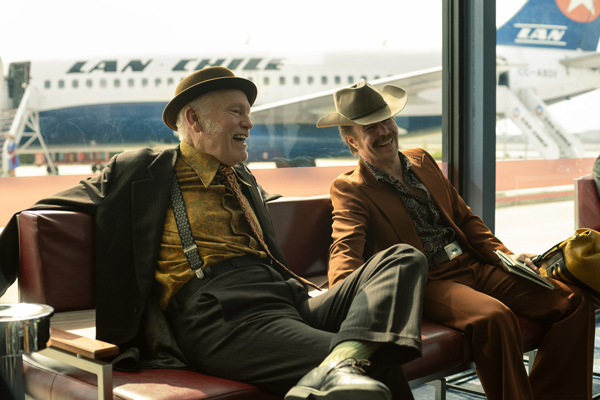
With the stage set for the September, 1973 coup to take place in Santiago, Chile, CIA agents Chris (John Malkovich) and Lee (Sam Rockwell) fly to Rapa Nui aka Easter Island for a brief vacation. Their trip is being closely monitored by their bureau chief, MJ (Steve Buscemi) as Chris, who is battling a terminal illness, has been talking a bit too loosely and threatening to write his memoirs, which would include explosive information regarding the CIA’s involvement in the assassination of both Patrice Lumumba and John F. Kennedy. MJ isn’t aware of Chris’ request to have Lee euthanize him on the island before the trip is up. However, a pair of collegiate Chilean women (Mariana Di Girólamo, Ailín Salas) threaten to interrupt their best laid plans.
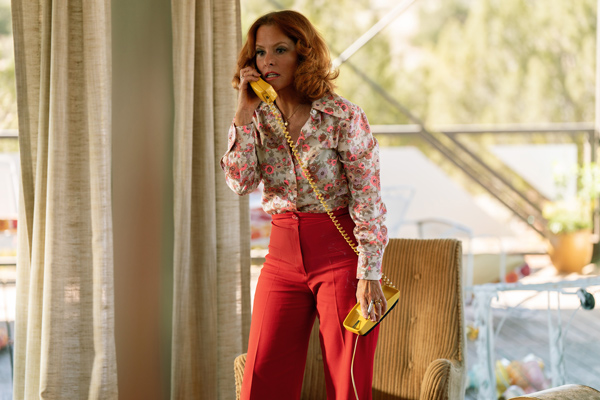
The tonality of Wild Horse Nine feels a bit like The White Lotus on an Oliver Stone kick as Chris’ involvement with JFK’s assassination begins to take shape during the nascent recordings of a memoir which will never see the light of day. Malkovich is quite destructively droll, a curmudgeon who is easy to despise, like a more subtle version of cantankerous brutes he’s already portrayed in films like Burn After Reading (2008) or the caricature cult leader in Opus (2025). He’s perfectly cast and ultimately a bit tiresome sans some excellent passages comparing Democracy as the environment which allows for the proliferation of queer people, and, therefore, excellent cheese. Since this is a period piece meant sort of as a prologue for the miasmic chaos currently ongoing in the United States, some of the anachronistic dialogue is arguably forgivable, as the usage of ‘ish’ might be questionable for 1973, as well as the advent of correcting colonialist verbiage. But there’s also a point to be made here, as the assassinations of MLK, JFK, Patrice Lumumba and Salvador Allende, et.al., stymied the global progress of democracy, when tendrils of social advancement became paralyzed.
Rockwell, who won his Academy Award for Three Billboards, is essentially playing the ‘straight man’ in this odd couple, but he’s curiously not an avenue for catharsis. Scene stealer Parker Posey is his alcoholic, adulterous wife, featured in two scenes she absolutely nails with her deadpan delivery. As their bureau chief, Buscemi (who starred in Armando Ianucci’s The Death of Stalin, 2017, a comparable dark comedy with grisly depths) is likewise enthralling, a heroin junkie running from his own guilt. Tom Waits pops up for a cathartic moment as Malkovich’s estranged brother. An angry exchange about JFK ensues, pinpointing when his 1963 assassination turned the whole country into shit. “It was always shit,” Chris retorts. “We know now.” Illusions of decency have also been a part of halting actual progress.
With the exception of a naive student, none of the human characters in this are decent people, which explains why someone like the desensitized Chris, facing his imminent end, gravitates towards the innocent moths he painstakingly removes from his apartment. Moths are drawn to lights which cause their death (Virginia Woolf explicates their metaphorical subtexts elegantly in her 1942 essay The Death of the Moth), and Chris ironically provides the exact opposite service for them as he does humans. Likewise, the wild horses, collateral damage with the advent of humans, are also innocent, perceptive creatures symbolic of an old world order, a wild west the world can never return to.
If the title references a military code, the number nine is also textually significant, a symbol of a completed cycle (before a new decimal cycle begins) but also rife with allusions to Greek mythology (the number of muses, as well as the number of times the River Styx circles Hades). Tolkien’s Nazgul, basically a Nazified version of the Horsemen of the Apocalypse, are also nine corrupted rulers who become demonic entities in exchange for power. To quote the famed Q Lazzarus track “Goodbye Horses” – “all things pass into the night.” For all its comic charms, this is what Wild Horse Nine reflects, a night we haven’t yet passed through.
Reviewed on September 3rd at the 2026 Venice Film Festival (83rd edition) – In Competition. 118 Minutes.
★★★½/☆☆☆☆☆