

Where Did Our Love Go?: Schanalec Deconstructs the Break-Up Drama
 True to form, or rather, anti-form, Angela Schanelec’s latest exercise, My Wife Cries (Meine Frau weint), aims to defy the naturalistic approach to her theme and subject. This time around, a vaguely related collection of characters united metaphorically by a construction site find Mercury is in full-swing Retrograde as relates to their thinly defined relationships. To exemplify this, they all talk about it. A lot. A key figure of the New Berlin school filmmakers, who actively embrace anti-naturalism in their approaches, Schanelec’s film’s often excel with this approach, usually assisted by limited dialogue. Lately, as with her previous, even more experimental feature Music (2023), dialogue has been used more forcibly as a didactic mechanism, which brings with it a tediousness suffocating the experience.
While navigating a work-related issue with construction equipment, Thomas (Vladimir Vulević) has received a missed call from wife, Carla (Agathe Bonitzer). Once reunited, it appears Carla had been in a car accident with a younger man whom she’d met at an advanced dance class, something Thomas had declined to participate in. Carla’s dance partner died in the accident, but she’s more traumatized about what this means regarding her relationship to Thomas. While his initial reaction seems to be a migraine headache involving a trip to the hospital, Thomas internalizes the incident and relays specific dreams which he uses to convey what Carla means to him as a romantic partner. Additionally, their cohort of colleagues and acquaintances seem to be experiencing similar issues about what keeps them together once the honeymoon period is over.
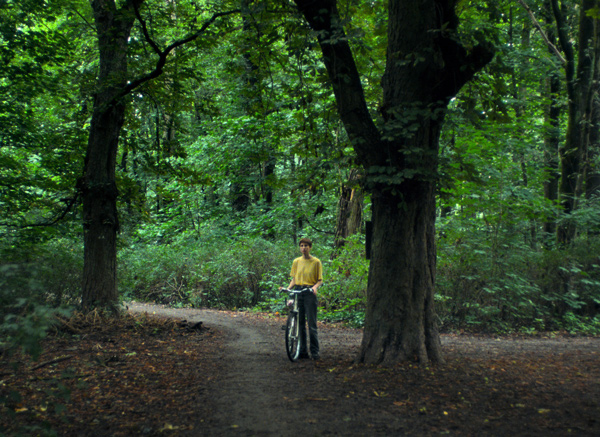
The central couple are Carla and Thomas, with most of the heavily lifting being done by Agathe Bonitzer (daughter of writer/director Pascal Bonitzer), which is ironic because we meet Thomas in a work dilemma where his ‘new’ crane has suddenly stopped working on the job site. From there, brief interludes with various characters whose paths have crossed with them, including both their co-workers, seem to indicate everyone, just everyone, is trying to grapple with their feelings about dissipating romance (an exception being Carla’s co-worker, Claudia, who seems solely defined by attending her tall boyfriend’s sports games). What ensues is a beautifully shot travelogue of Berlin, but it’s an experience which feels like you’re on a paid tour stuck next to the most obnoxious, naive thirtysomethings making stilted, adolescent conversations about banal life experiences.
Some of Schanelec’s best films, which are also about everyday life, include Marseille (2004) and the phenomenal 2019’s I Was At Home…But (read review), both featuring Maren Eggert, an actor who seems to know exactly how to reflect the director’s intentions. In My Wife Cries, Bonitzer certainly is the most ‘performative,’ and rises above the often grueling, incredibly labored exchanges of dialogue (the most egregious being with a Nobel Prize contending poet on a park bench). But she’s not able to serve as the same sort of conduit to interpret the bizarre artificiality prized by Schanelec.
The comedic undertones suggest this is merely the loquacious counteroffer of any number of divorce dramas (think any comparably chatty ‘relationship issue; Bergman films, except lobotomized and completely numb), but instead plays like a modernized, bloodless version of Reality Bites (1994). Schanelec even throws in a random pop song dance sequence to seduce the audience back to attention. If there have ever been any cast of characters in need of a significant addiction issue to kick things up a notch, it’s these milquetoast non-entities. However, DP Marius Panderu (Radu Jude’s Aferim!, 2015) does gives us a scenic tour through the summery foliage of Berlin. Sadly, in My Wife Cries (which she doesn’t, at least not literally), we shall never see a character ‘as lovely as a tree.’
Reviewed on February 16th at the 2026 Berlin International Film Festival (76th edition) – Main Competition. 93 mins.
★★/☆☆☆☆☆